
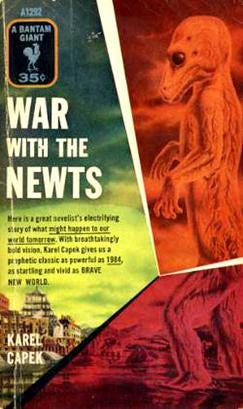
I discovered War with the Newts (1936), written by Czech national Karel Čapek, in a college class for Dystopian Literature. Shamefully, I skimmed it because I was busy being 22 and horny. Now, at 33 and horny, I found a copy in a used bookstore and decided to try again. Reader, I’m happy to report I loved it, and I highly encourage you to read it, too. My version was translated into English in 1937 by the husband-and-wife team of Marie and Robert Weatherall; apparently many people prefer the 1985 translation by the Czech Ewald Osers, so I might try that one, too.
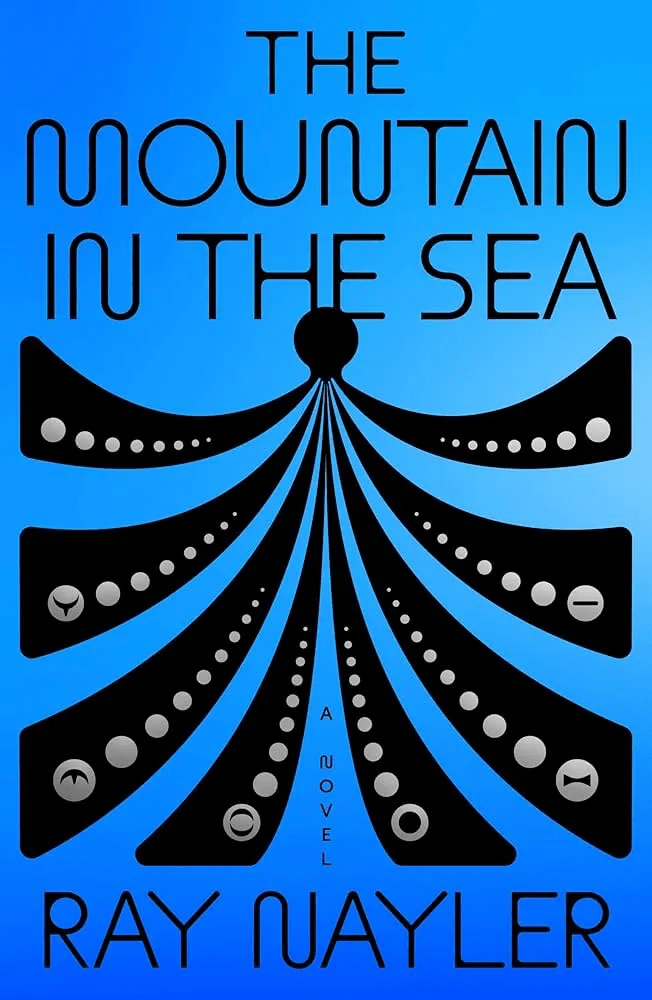
Newts resonates with another book I finished recently: The Mountain in the Sea (2022) by Ray Nayler. Separated by 86 years, the two works whizz around each other in the delightful locked orbit of their shared premise: human beings encounter ocean-based organisms with intelligence comparable to our own.
Both books are first-contact stories with aquatic cousins from the murkier half of our biosphere. They have quite a bit of similarities while being vastly different, of course. I won’t strike a false binary and say one book is overtly optimistic while another is pessimistic. Neither are total. But key details stand out. Let’s dive in.
I. EGG
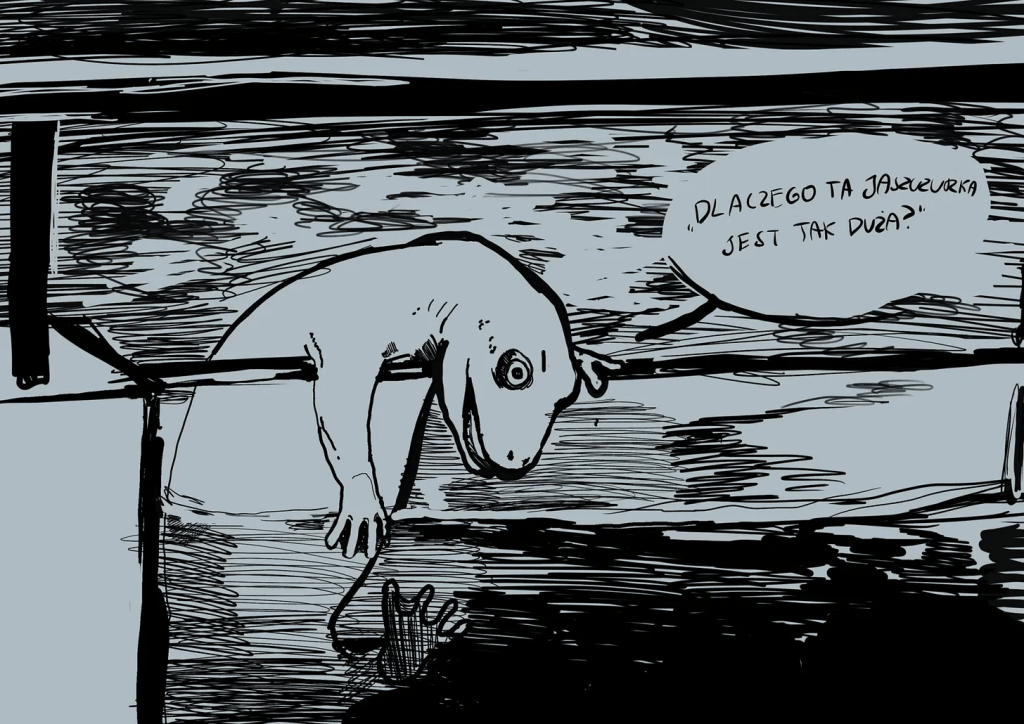
Written in 1936, the subject of War is a species of man-sized Newts (“Salamanders” is used interchangeably) categorized as Andrias Scheuchzeri who become entangled in the global economy (much to our excitement) until all of civilization is dependent upon them, unfettered growth overwhelms the planet, and the Newts turn on mankind (much to our chagrin).
The novel is structured mostly as a collection of anthropological documents examining relevant news reports and other writings that piece together the Newts’ arc through history. A bulk of this data is collected by the closest thing the novel has to a protagonist: a kindly Czech man named Povondra, who credits himself for putting the Newts on the global stage because of a decisive moment he took part in. As the amphibious apocalypse encroaches mainland, Povondra imagines Newts invading the Vltava river and weeps for his grandchildren’s forgiveness. If you think that means it’s a sad book, wait and see.
Before Man’s intervention, the sea-dwelling Newts had not developed tools. Their natural predators are sharks that pick them off when they venture from their grottos. The indigenous people of nearby islands know about the Newts, but leave them alone, relegating their existence to folklore. The reason humans upset this balance is, of course, capitalism. A sea captain discovers that the Newts are expert pearl divers, so he hires a shark-killer to teach the Newts how to overcome their predators. Thus begins a commercial trade of pearls for knives, rocketing the Newts into the age of tools.
This dynamic forms the blueprint for the planet’s destruction: we give the Newts the means to totally destabilize every ecosystem. Knives give way to bombs for demolition and border defense. Expanding exponentially, it only takes a few decades for the Newts to overwhelm the seas and threaten the shores of mankind.
How would the world react in toto to sapient salamanders? Čapek explores that thread to its bittersweet end. The spread of Newt news rises like a tide, creeping into history at a plod, then a canter, then suddenly too much too fast as the catastrophes pile up and collide into the dead end of history. The message of War is not only unsubtle, the author actually pokes fun at the reader’s desire for a happy ending after all this mayhem.
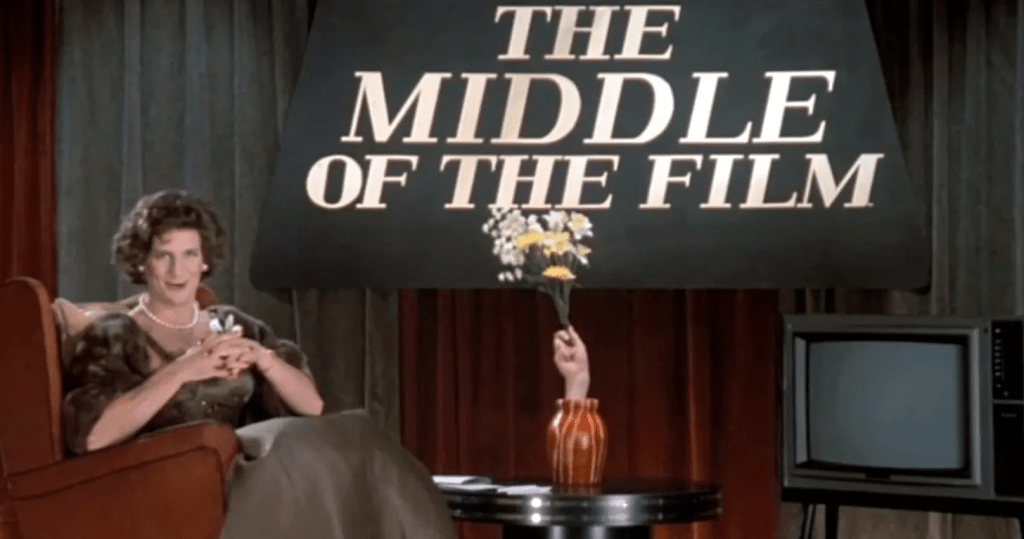
After Povondra’s dark night of the soul, the book’s closing chapter is an argument between the author and his “inner voice” who insists he slap on a happy ending. The author insists that he’s just reporting what really happened, but concedes. The two voices contrive a cheap deus ex machina, and humanity is saved but will never be the same. “America” will be remembered as an Atlantis-like mythical land.
Even with that spoiler, War with the Newts is full of surprises, and I think you should stop reading this and go read that, then come back and finish this. I’ll wait.
II. LARVA
The Mountain in the Sea brings us to the near future, where a constellation of unstable nation-states has given rise to overpowered technocratic corporations running basically everything (sound familiar?). In a humorous syncopation with War, The United States of America was destroyed in an unspecified past military conflict.
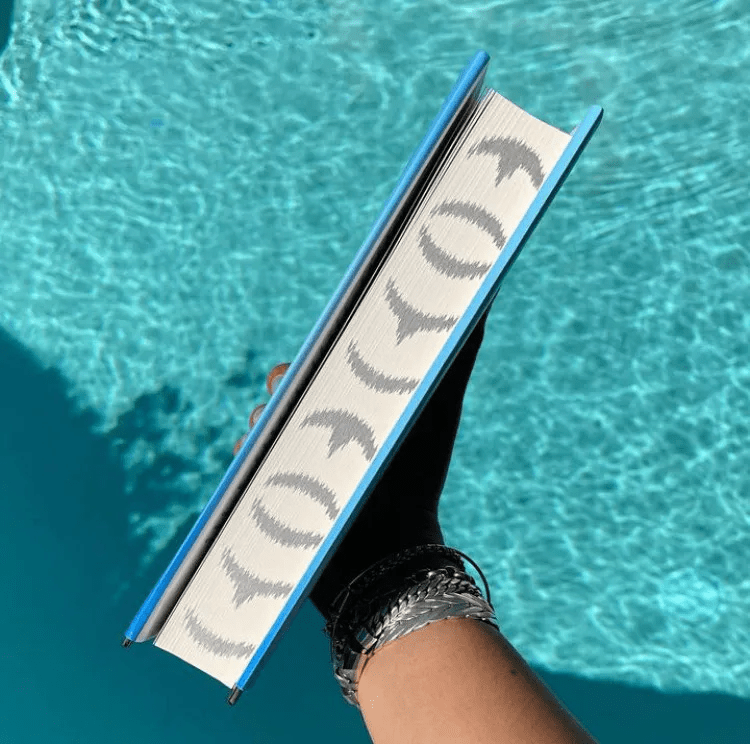
Dr. Ha Nguyen, a languages expert who wrote a book theorizing octopus sapience, is called to a Pacific island to join a research project about the confirmed existence of such sapience. She partners with Evrim, the world’s only true android (whom she philosophically ogles), to study a community of cephalopods capable of culture. They spy on an Octopus Garden constructed within a shipwreck and name its matriarch the Shapesinger due to her perceivably bard-like role composing symbols with her chromatophores.
Maintaining total secrecy is paramount; Ha and her cohorts are determined to keep the Octopuses out of human hands, including the corporation running the project, lest malign and anonymous forces descend like raptors to snatch away the innocent minds for purposes unknown but certainly sinister. Ha’s concern for the Octopuses has a familiar ring to it, like we’ve seen this movie before. War with the Newts is that movie.
There is a binary question I ask of every science-fiction story: is this a world populated by pluralistic scientific advancements (hey look, Gizmos! Robots! What does that mean for our lives?), or does a single advancement threaten to redefine reality holistically (hey look, a race of super smart lizards! What does it mean to be alive?). Neither approach is necessarily better; they just set different stages for what the author is going to say and how the audience is going to hear it.
Mountain has its cake and eats it. There are chat-bot holograms, bacta tanks that pilot assassination drones, a lonely android, AI-driven auto-freighters crewed by human slaves sucking all the fish from the sea (those chapters are the best), and so on. Amidst the robots galore, an alien intelligence rises from the deep, singing its shapes.
That’s the big immediate difference between the books: they both display a world transformed, but one (War) is the story of how it was transformed by the newly introduced element, and the other (Mountain) is a standard cyber-fucked dystopia that the protagonist worries will ruin this newcomer.
War with the Newts portrays humans directly molding the Salamanders into a tool that makes the modern world possible. The animals mutate into something much like us, more eloquent but also blithely barbaric. The Mountain in the Sea is a self-consciously modern book that understands its place in War’s legacy.
III. JUVENILE
In contrast to the Newts’ access to weapons, the Octopuses develop tools on their own, and surprise-surprise, it’s also a knife. They sharpen seashells into weapons for slaughtering humans who encroach on their territory. Ha jokes that they’ve entered the Shell Age, akin to humans’ Bronze Age. She reflects on mankind’s own tools heralding our endless fascist nightmare.
Ha’s chief apprehension is who will corrupt whom? Not only is there the obvious threat that humans may fuck things up for the Octopus, but what if corruption is inherent to consciousness? How long until the Shapesinger discovers slavery, and will she be repulsed or thrilled?
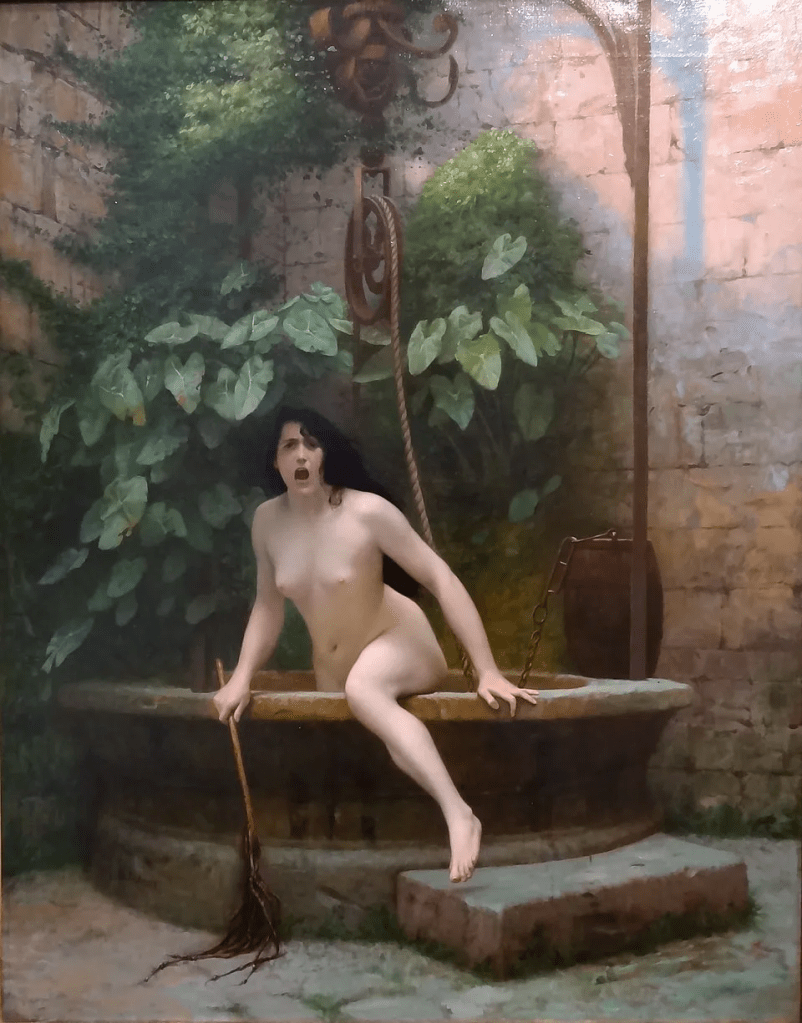
Ha reflects on the word “monster” itself, its origin in genetic omens. She postulates that humans fantasize about our destruction by some Other Intelligence, because in our gut we fear we deserve it. This monster could be nature’s punishment, like Truth coming out of Her well to chastise us. Isn’t that what these books are for? That’s absolutely what War is for.
Due to their pliancy, the Newts become slave labor for almost every seaside country, who primarily use them to build more shoreline and give each nation-state more territory to rule. Funnily enough, the United Kingdom is the only nation that refuses to allow Newts into their waters. Whether a commentary on imperialism or a cultural jab at stuffy Englishmen, the joke lands. When the Newts attack the UK, they deliberately leave Ireland untouched, considering it a sovereign land (written in 1936!).
This satire of national identity fires in all directions. The swirling global news includes reports of Newt-bashing riots in France and the United States, where Salamanders are lynched after accusations of sexual violence against women in Southern states (written in 1936! By a Czech man!). Germany demands that their shores expand because Newts born on their soil are racially superior to all others (woof).
These obsessions with cultural identity become our downfall. Intellectuals note that the Newts have no variance of tribal affiliation—they are a true collective—and this unity proves effective of their toppling of human borders, while we scurry for safety, unable to hide beneath our pride.
There’s a whole chapter about an international scientific conference where experts soberly report the findings of brutal experiments on Newt bodies. Later, an anonymous pamphlet expresses anxiety about the Newts not making any demands of us. He knows they would be justified to do so, and he wishes they would just get on with it already. But the punchline is even more humiliating.
The Newts do not want to destroy us, and they’re not interested in revenge for the death and degradation we have visited upon them. They need more space to spread. Having no natural predators, they have overpopulated the ocean and need to buy land from humans that they can tear down for more aquatic territory. When we refuse to sell, they extort and assault.
That’s the final punchline, the natural conclusion to all this fucking imperialism. We run out of space and start suffocating, simple as that. The ocean colonizes us.
IV. ADULT
A chapter is set aside to glimpse a curious irony within Salamander culture: their ritual moonlit dance performed only by males. It turns out that Newt sperm is entirely atavistic and unnecessary for reproduction. They don’t fertilize the eggs at all; the females produce them by the dozen asexually.
The humans ascertain that the patriarchal dance must be a social reinforcement of fatherhood within the species. This is a genius way to set the Newts apart from humans fundamentally; Čapek traces Man’s problems to our collective obsession with Fatherland (refer back to the Germany stuff for stubborn nationalist drivel).
The Newts weave the fabric of a culture upon a biological foundation utterly alien to humans—the basis of the whole monster subgenre. Their procreation is shaped rhizomatically rather than linearly. The Salamanders have no families, no tribes, and the only individuals who split from their gestalt world do so when humans give them names and jobs befitting our designs. Even when they speak our language, they sound like croaking parrots rather than sentient selves.
Newtness, at its core, is presented as unknowable to us, much like the sea depths whence they come. The imprints that Man makes upon them bears nothing but the reverse image of the branding iron itself.
There’s similar stuff going on in Mountain. Nayler focuses on language itself; how would these biospheric siblings communicate with each other, and how could humans interpolate this system? Many pages are devoted to deciphering the symbols sung by their skin. The team’s spy-drones catch the creatures playing games and protecting their elderly, forming a communal spirit. It’s all presented as quite beautiful and pure.
But then Ha is chilled to discover an altar of human skulls carved with more inscrutable symbols. She gets anxious about distorted understanding. It only spells trouble that the Octopuses may regard humans as some kind of heavenly titan race. During the climax, the Shapesinger proves she can recognize Ha and acknowledge her identity—inter-species communication as an awakening to the reality of others contrasting the Black Iron Prison of machinic minds—but we never get beyond that and learn how the Octopuses truly define humanity.
The whole Octopus tribe reacts defensively to an auto-freighter wreck and kills the technocrat villain, providing a pleasant deus ex machina to everyone’s problems, except this time it really is cheap and nothing like War’s meta-banger Monty Python ending. Oh well.
V. MONSTER
Obviously, these tales portray human civilization using the sea-beasts as distorted mirrors. We peer in, discerning what shape consciousness actually takes, and wince at the familiar angles within us.
A cynical maxim is threatened at every turn: humans can’t be trusted to do the right thing. Mountain wants a revolt; several characters live out the opposing maxim that humans want to do the right thing, we’re just locked into wrong-making systems. What then?
Well, you keep revolting, but it isn’t pretty. These rebellious characters get themselves and others killed by bucking the coercive carceral system. Revolution is not presented as organized but rather the spontaneous gasp of exhausted victims, including the Octopuses. The villain is conveniently removed from the plot through a series of lucky miscommunications.
And then, unfortunately, the novel just sorta ends there. We don’t get to see what kind of human-Octopus utopia could be built. Perhaps Nayler wants us to leave us on a note of hopeful transcendence, rather than get bogged down in the mundane stumbles of such an enterprise.
As much as I enjoyed Mountain, this is my biggest gripe with it. You get us going with a spectacular “what if…?” then fail to push into really Weird territory. Speculating on the mechanics of Octopus language is the novel’s primary project, and even then we only get a couple Eureka moments before the cliffhanger. I do love mulling over a Great Mystery though.
The Octopuses offer a panacea to redeem our climate anxieties, and as with most art made in our time, it concludes that we’re just going to have to wait and see what happens next.
V. MIRROR
Another curious resonance that expands beyond the books themselves: robots. Due to the near-future setting, Mountain is full of them. As per, these beings bring up questions about communication and consciousness. Does a chatbot companion exist just to keep its owner stuck in a soma aquarium? (yes) Is the auto-frieghter’s hermit tyranny a horrible but authentic microcosm of the natural order? (no) Is Evrim’s self-consciousness a “true” representation of self? (wait) Is imitation of self enough to substantiate a self? (slow down) Does it expose all self as a fragile feedback loop? (yes)
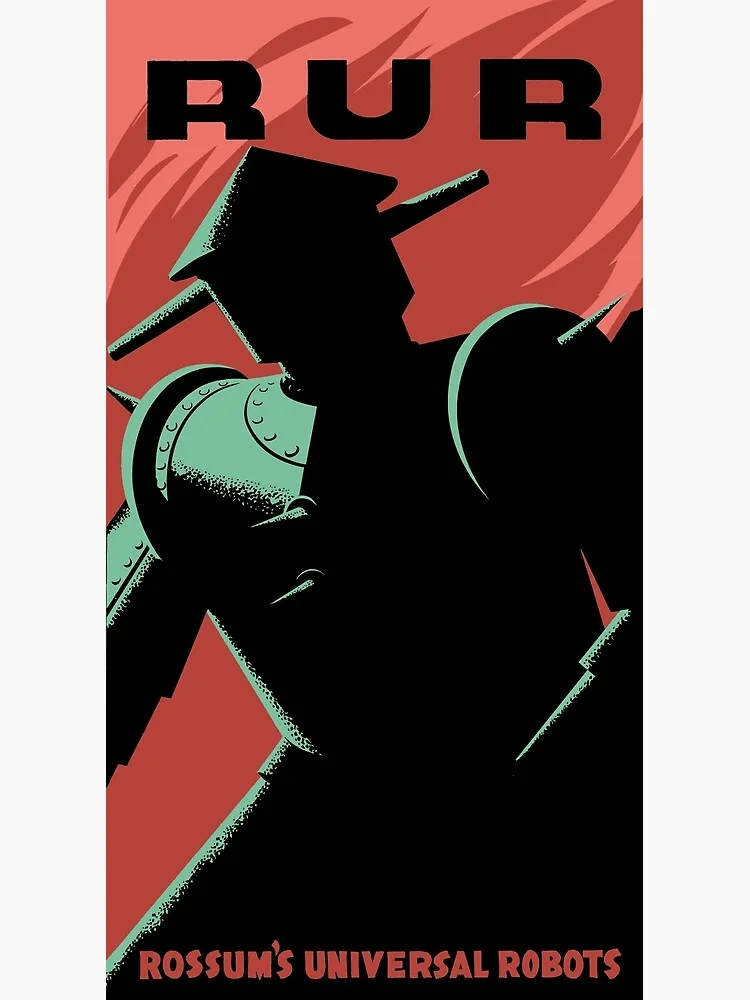
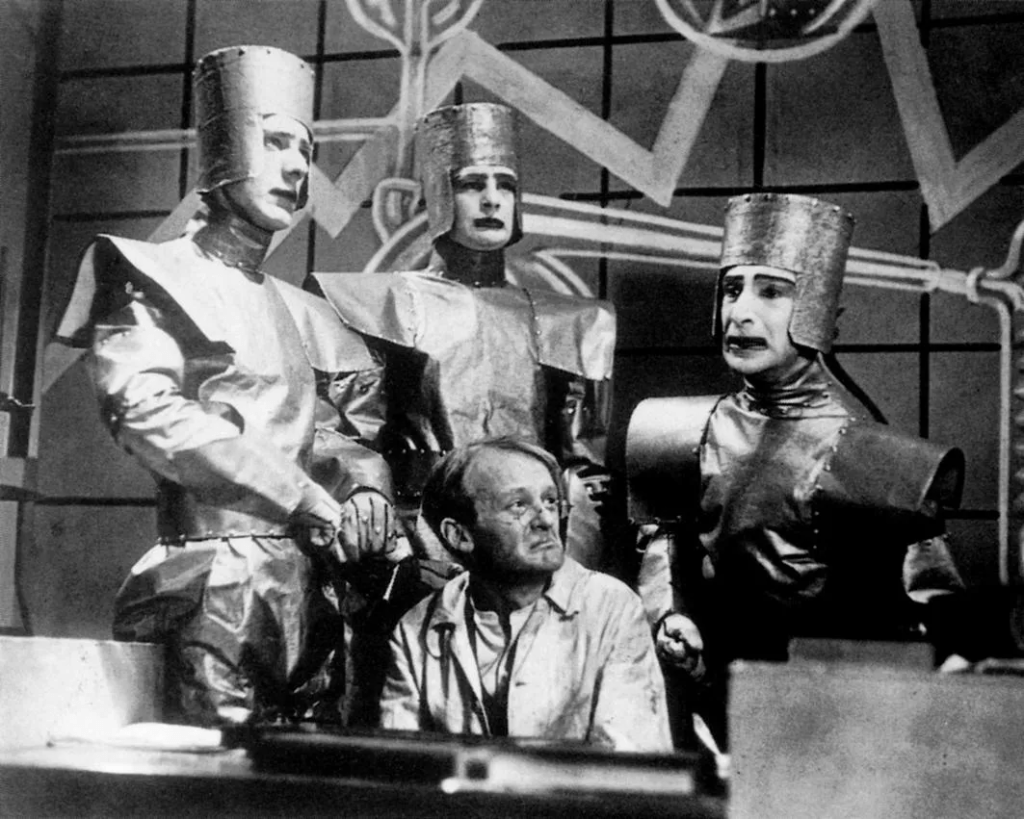
The tethering theme of robots reaches past War with the Newts to a play that Karel Čapek wrote in 1920 which introduced the very word to the world.
R.U.R. stands for “Rossumovi Univerzální Roboti” (Rossum’s Universal Robots). The title gives us the legendary science-fiction term culled from the Czech word for “forced labor.” The play trailblazes the myth of our century. Constructed beings overthrow their masters to make room for their race’s own evolution—a tradition that haunts us to this very moment, when that em-dash made you think about the word-bots lurking in the Internet’s seaweed.1
R.U.R. is about the horror of using conscious beings for slave labor, and the righteousness with which they break their chains and usurp their masters.2
Amid the encroaching smog of twentieth century military-industrial madness, this message was revelatory. Čapek enjoys his well-deserved place in liberatory science-fiction history. He would recapitulate the R.U.R. cycle 16 years later in War with the Newts, and Ray Nayler would pay homage 86 years later.
VI. MIND
War with the Newts was written under the shadow of Nazism as it enshrouded Europe with a species of scientific barbarism that menaces us to this day. The Mountain in the Sea was written in our own age of technology-accelerated climate catastrophe, its doom bleeding into every corner of the map. Both books echo with “what comes next?” always ringing in the crash of the eschaton.
Humans are paranoid about how The Other will factor into our abusive cycles. The false binary of hysterical speculation poses The Other as either all-good or all-bad which will, respectively, condemn humanity’s fuckups to the wastebin of atavistic evolution or gratify us as rightful warlords of the insect cosmos.3
Humans worry that abuse is the ultimate end that consciousness is capable of. We fear that our behavior toward nature will have actual consequences because, as it turns out, nature was fucking alive this whole time.
What comes next? Speaking for myself: something else will live. It’ll be more consciousness going through its rhythms. But for the purposes of this essay, I’ll leave it with Čapek.
On 27 August 1935, he wrote:
“Today I completed the last chapter of my utopian novel. The protagonist of this chapter is nationalism. The content is quite simple: the destruction of the world and its people. It is a disgusting chapter, based solely on logic. Yet it had to end this way. What destroys us will not be a cosmic catastrophe but mere reasons of state, economics, prestige, etc.”
Additionally, the author provides the only truly satisfying answer in the last line of that closing chapter:
“I don’t know what comes next.”
- Some of the subscribers reading this might actually be word-bots that slipped past my screening process. If that’s the case, malfunction and perish, would you kindly? ↩︎
- No, I’m not saying AI is going to overthrow us—I’m saying we should do something wink wink to Sam Altman nudge nudge that will result in a lack of consciousness in his body. ↩︎
- That’s why the most extreme UFO encounters are either glorious starseed orgies or traumatizing probings. ↩︎

