
I was reviewing some notes from a furious writing session earlier this year and came upon the line “The poetry of pain is gone. Now it’s ambient noise.” Something to chew on during the following diversionary detour.
I don’t wish to denigrate the great traditions of Horror literature & film, but I stand by the superlative: video games are the perfect medium for the genre. They open the door to a fully immersive experience that does not reduce Horror to a mere track of scripted scares but elevates it into a literal walking nightmare. The really good ones don’t target the senses alone, but go for the guts—stomach, heart, and brain. Bladder, too, obviously.
To celebrate the darkening season, I spent the year playing every entry in the best franchise to make players pee their pants haplessly.1
Amnesia is an episodic series of vintage settings within a shared universe of supernatural horror. Each tale colors in a mosaic, its lorific fragments eking through immensely satisfying (and fucking scary) gameplay. Whole nights found me gripped with shivering insanity because of these cursed tomes. Beyond jumpscares, creepy monster designs, and hair-raising survival tactics, each game makes the player themselves into a monster, and I’m not talking teratological abnormality. Ethical dilemmas are the bleeding heart of the game mechanics and final statements. There are scenarios where you can choose to hurt the innocent for your own gain.
Without getting too much into the weeds of lore, the central speculative conceit is simple: what if suffering can be magically transmuted into energy? What could be invented from that? What civilization would build itself upon such inventions, and what individuals would populate and control these systems? The range of this concept is explored thoroughly, from Inquisition-style medieval torture devices, to a mechanized steampunk slaughterhouse, to fields of Egyptian-adjacent ancient-alien organe-extracting Matrix-battery sarcophagi. The results are quite obviously horrifying.
And the monsters, oh, the monsters. Human bodies, bloated or emaciated, deformed into all manner of shapes groaning with the weight of centuries. Bestial things bellowing and snarling in eternal agony. Glimpses of former selves peek through the shambling grotesqueries only to feed the player a spicy shiver in the widely spread feast of suffering. Deeeeelish.
The storytelling strategy receives its cues from Poe and Lovecraft, especially through epistolary breadcrumbs, suggestive cosmicism, and narcotic insanity. Each game’s finale involves a moment of anamnesis2 where the character is implicated in some unspeakable ethical atrocity, eliciting a reaction of revulsion from the player realizing they have guided the hands responsible for such deeds. The titular ingredient—that the characters can’t remember having committed it—is how the player is fused to their experience, like an etheric spirit bound within a sacred circle by a malicious witch.
Each entry in the Amnesia series illuminates multifarious tunnels in the deeper mind of the archetypal protagonist whom the player must discover. While split between various individuals, I regard the game experience as an experimental frolic through a shared selfscape with the player as zygonaut. Follow through the trapdoor and mind the unusually large rats…
Spoilers, obviously.
I. The Dark Descent (2010)
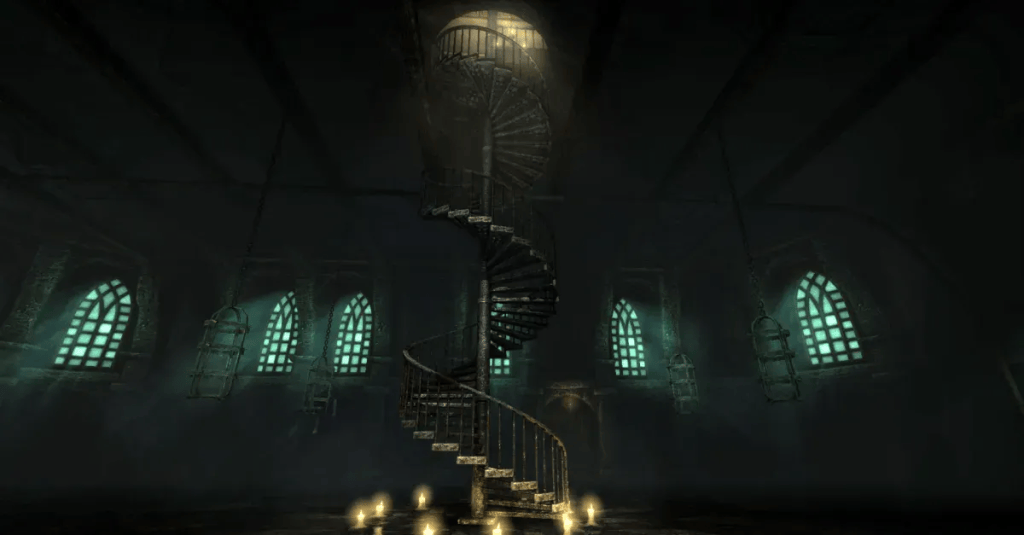
The opening salvo kicks everything off with a spooktacular spiral into doom-drenched madness. The Dark Descent is Gothic and Weird. It is August 19th, 1839. You wake in a castle in the Prussian woods. You discover a letter written by someone about to drink potion to erase his memory. The letter wants the player to find the sorcerous master of the castle, the villainous Baron of Brennenberg.
Descend into the darkness where Alexander waits and murder him.
Your former self,
Daniel.
The Dark Descent establishes what would become Amnesia fundamentals: a split soul passes through a dreary hell, pursuant to the methodical uncovering of its buried half. As the player gathers Daniel’s diary, you discover what kind of man you once were. With that knowledge, you can decide what kind of man you want Daniel to become. I’ve always loved characters presented as tabula rasa, totally unmoored from origin. The self as a clean slate. I’m not fond of the theory as it pertains to actual psychobiological existence, but in video games anything goes, baby.
As for gameplay, the first and foremost mechanic is darkness. If you remain in the dark too long, Daniel succumbs to fear and passes out. The player must gather resources for maintaining light, like matches and lamp oil. Increased fear heralds visual and auditory hallucinations, wriggling shadows, squishy crackles, sinister whispers. These sensory phantasms mingle with very real encounters the player has with various monsters stalking the halls.
They are named Gatherers because their job is to kidnap victims for Alexander’s obscene alchemical experiments. Resembling drowned corpses, they are bloated prisoners shambling around in endless moaning. Sometimes their appearance is triggered by a choice the player makes. Sometimes they patrol in a loop. You can hide in closets and corners—quivering in terror, both in the game and in real life. Oh, and even looking upon a Gatherer increases your fear. Yes, they gamified Lovecraftian madness. The whole thing reminded me of The Case of Charles Dexter Ward, with its immortal warlock crypt vibe.
And then of course, the parchment. Important information for solving puzzles and mapping out your environment can be found on scraps lying around. These also regale the player with backstory—carefully doled out dollops that festoon the physical descent. I am ravenous for this storytelling tactic; it’s the main reason I love the games. I treat each page like a gold leaf and gobble the words into my drooling face holes. My apprehension of the larger tale grows with each addition, and I always wonder if I’m missing some essential piece to make it more clear, or if those details were selectively elided. Participatory narrative. What can the hand grab to bring to the eye? What does the eye make of the data? What can be known?
The deeper you crawl, the darker it gets. The player discovers that Daniel had come to Alexander seeking help for a curse. The treatment requires Vitae (a speculative application of the alchemical concepts Aether and Aqua Vitae), which is generated from suffering. Daniel and Alexander tortured innocent victims to magically stave off his death. Daniel’s guilt over his atrocious complicity drove him to take the obliviating potion, and here we are. There’s great horror in this circumstance: cruelty not for its own sake but for survival. Alexander actually uses the obliviating potion as a step in the torture formula, so he can keep renewing victims’ sense of hope and start the torture up again. The darker it gets, the deeper you crawl.
Daniel navigates various dungeons, gaols, torture chambers, all a sprawling subterranean complex designed to enhance pain. Throughout, Daniel remembers the suffering he inflicted on the victims here. You discover that Alexander is an ancient being from another dimension trying to use the energy-generating torture to open a portal home. There is a brief mention of him yearning to be united with someone he loves on the other side. There is a cancerous blight of red flesh called The Shadow following Daniel through the halls, and an invisible monster at one point, echoing The Dunwich Horror and The Unnameable.
The game’s finale presents options in dealing with Alexander that may include Daniel’s self-sacrifice, all with the help of a fictional version of actual historical occult philosopher, Heinrich Cornelius Agrippa. It’s a lot of fun. Here’s further reading on the moral dimensions of The Dark Descent. I really enjoyed the game and could see its well deserved impact on Horror history. Strong characters supply much needed pathos to any experience that involves terrible suffering and death. Otherwise, why should we care?
By engaging with the player as the “present version” of himself, Daniel schisms his soul. The potion allows him to commit metaphysical suicide, incepting the birth of “you” the player, who is not the Daniel in the diaries. You are a memory-homunculus, a fresh mind forged from a malignant geas and forced to trudge on a quest bequeathed by bloodied hands that are now yours.
And they only get bloodier.
II. Justine (2011)
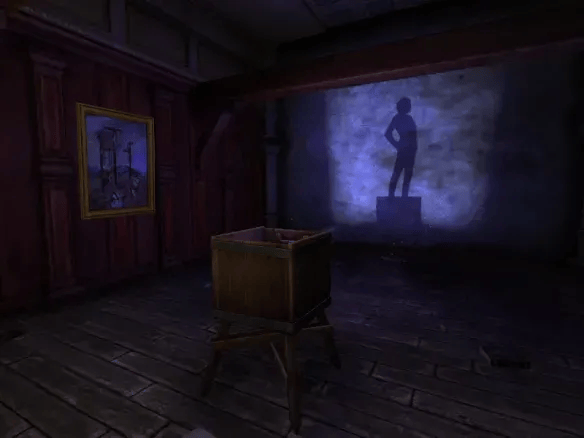
The Dark Descent’s little sister. This entry is a DLC released as an add-on oddity: a short story with no game-saves, which means if you die or quit, you have to start all over. Here, Amnesia had an evil baby with Saw. In 1858, the unnamed player wakes in a Parisian dungeon where a sadistic eponymous woman communicates via gramophonic wax cylinders.
Justine Florbelle is like The Riddler meets Bioshock’s Sander Cohen. She forces you through her Cabinet of Perturbation3: a series of puzzle rooms containing victims bound to elaborate torture devices. The choice is simple: find a way to trigger the contraption that will kill them or find an alternate process that will spare them. The way forward only opens once you choose.
The murder methods are more obvious and what Justine wants the player to do. The merciful path is not quite apparent and requires creative thinking from the player. I actually had to cheat and search online how the hell to not kill these bastards. Just to amp the fear factor, there are emaciated prisoners chasing you named Suitors (very funny). These foes are not the products of magic, they’re just torture victims out for revenge, which honestly makes them scarier. They all have their eyes gouged out and follow you based on sound.
Scraps of letters and diaries reveal that Justine’s father was a trailblazer in psychology and raised her as more of a patient than a daughter. There are letters from characters in The Dark Descent, and Florbelle may have been involved in the same occultist cabal as Alexander. There is also a diary entry suggesting incestuous abuse, because why not? If Freud can get away with it…
As you might have guessed, Justine ends with the revelation that the player’s character is, of course, Justine herself after self-oblivation, and the Cabinet of Perturbation is her continuation of her father’s psychological experiments into the soul. Oh, and she murdered him to inherit his fortune, natch. It ends with Justine emerging to her mansion above the dungeons and casually preparing for dinner.
This is the noblewoman’s way of periodically bemusing herself—literally, when you consider her wax cylinder quips address the player directly. She opens the first message declaring that her voice is a message from the past. In a weird way, this means the game constitutes therapy through experiential journaling. Justine enters a hologram of psychopathy, populated by her crimes. She must choose between cruelty and mercy, then escape the clutching hands of men she has imprisoned in this demimonde of her subconsciousness. One trap features an interpretation of magic lantern slides: pick a combination of silhouettes that will either spare or kill. For further reading on the topic, here’s a great piece on the psychology of Justine.
You’d think she’d integrate these experiences into her daylit self, except she will later annihilate it with another round of Perturbation. Justine exists in a closed cycle of addictive destruction, a genius bit of character work for a one-off villainness. This game, con la torturatrice, is more Edgar Allen Poe than HPL, but the “tattered king in yellow” makes a cameo as a mad wall scrawling, betraying the game developers’ larger preoccupations. It’s interesting how much the French decadence conjures Robert W. Chambers’ writing style in a way so few Weird pretenders can.
With two entries in the can, we ascertain what an Amnesia game is meant to feel like. Souls asunder. Murder, mutilation, madness. These siblings set the foundation for the rest to build a cyclopean monument to suffering, be it fictional, historical, fantastical, or wholly unimaginable.
Now, let’s get gross.
III. A Machine For Pigs (2013)
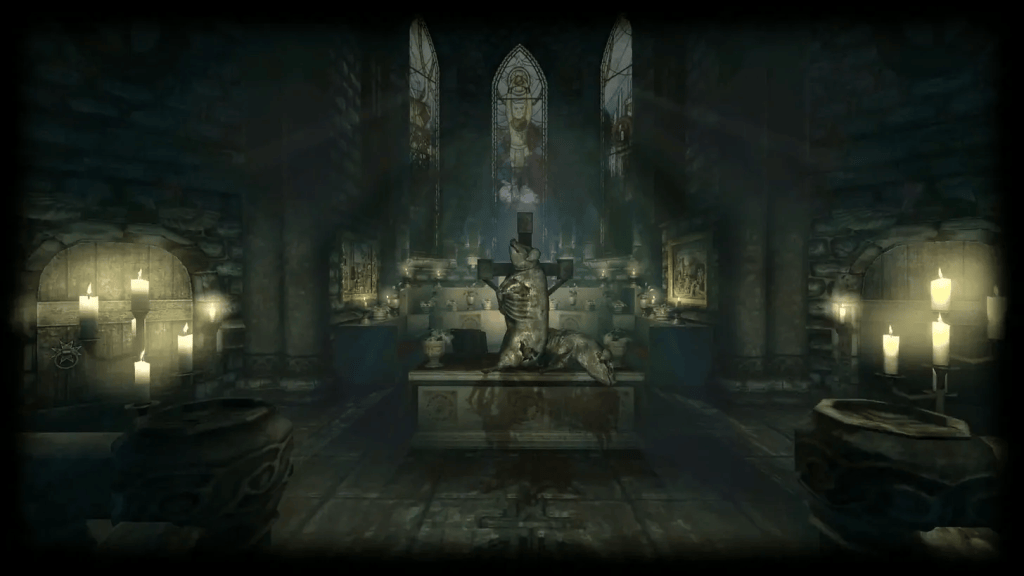
This squealing sequel expands what an Amnesia game is expected to focus on, especially with an emphasis on atmosphere. The setting is the literal turn of the century: December 31st, 1899. You play Oswald Mandus, a tycoon who wakes in his London mansion and wanders into his gargantuan underground factory in search of his young twin sons (don’t get attached). Mandus is a luminary in mechanized butchery, so you can imagine where the game goes from there. I even love his name because it feels like an industrialized update of “Magus” which fits the character.
Just as with Justine, the player is led by a voice named The Engineer calling from various telephones guiding you deeper into The Machine, instructing you to clear the flooding, repair, and reactivate The Machine, all in order to find your sons. And just as with The Dark Descent, the player comes to realize that their character has fathered the very horrors you confront & combat. The particular flavor of A Machine For Pigs sets it apart from The Dark Descent with its aesthetic evolution—hoary gothic wizardry gives way to greasy Victorian sci-fi. Twisted folkloric ghasts are replaced by mutant Manpigs—slavering hybrids of biomagickal experiments in which the actual word “orgone” is used (delightful to me personally). Journals reveal they are retro-engineered from a Gatherer corpse recovered from the ruins of Brennenberg Castle.
The Manpigs are the heart & soul of A Machine For Pigs. They maintain The Machine and represent the primary gameplay antagonism. They are scary, disgusting, wretched fucks in every size. One terrific segment follows Mandus through a cell block, where the monstrous porcine slaves wallow in squalor and offal. The affect here is less fear and more pity, especially when the player learns that Mandus himself is the progenitor of every single one. The Manpigs are a mixed herd of human cattle snatched off the street during false charity events and high society soirées, all propped up by Mandus. By uniting the low and high-born into a flattened class of beasts of burden, Mandus makes a sardonic joke about the trajectory of civilization. Very “steampunk body-horror Sweeney Todd.”
You at last discover that The Machine is a monument to grief and loathing. The bits of backstory spell out a visit to an Aztec temple where Mandus acquired a magical relic (blah blah blah, shared Amnesia lore) that granted him a prophetic vision of the 20th century. He witnesses war and genocide on a colossal scale, including his own sons’ deaths at the Battle of the Somme.
Driven mad by this dark portent, Mandus built The Machine and—in order to spare them a mustard gas fate—murders his two sons. In the spirit of Aztec eschatology, the child sacrifice imbues The Machine with godlike power. This unbearable sin splits Mandus’ mind, and his animus at mankind becomes the animating principle of The Machine (with The Engineer as its voice). It also conveniently erases his memory. This plot mechanic is a bit more esoteric than a simple memory potion, but it serves.
For the finale, The Engineer has manipulated Mandus into activating The Machine in order to enact an apocalyptic assault on humanity. The Manpigs flood the London streets, dragging people into ravenous furnaces. Via industrialized mass ritual sacrifice, Mandus conjures a funhouse mirror of the coming atrocities. The Machine’s demented goal is to wring out humanity’s freewill and avert Mandus’ vision. If left to our own devices, mankind will wreak meaningless havoc, but The Machine transmutes suffering into an orderly power supply to justify its own existence. This all sounds very familiar in 2026.
When you reach the heart of The Machine, you discover it is literally Mandus’ beating heart. No ethical choice endings here. Removing the organ triggers a vision of Mandus climbing the steps of a steampunk Aztec temple assailed by his prophetic vision. Things get heavy, as The Engineer implores Mandus to keep The Machine running, so that it can cleanse the world and prevent the historical horrors. This speech is a piece of powerful writing. At the top, Mandus sacrifices himself to shut down The Machine, reintegrating his soul and dying with it. Simultaneously, the calendar flips over, and the 20th century begins.
I’m quite fond of this game. The bleak atmosphere adorns a chumtastic carnival ride into hot sticky hell, where beats a bleeding heart of hate. Whole thing goes down like a tall glass of absinthe. The origin stuff gets a little messy, and the idea that the Manpigs alone could sufficiently end the world is a bit silly. But who cares? This game burns with incandescent animosity. There are numerous tirades extolling a well hewn revulsion at what modernity has turned us into. The horror that you built this, and you must destroy it. We are the pigs. The conclusion poses the grinding wheel of history as a technocratic cog avec steel teeth designed to mulch us all. My kinda shit. The further reading for this one is a massive case study analysis by (who else) a German. Pair it with a big fucking plate of crunchy chicharrones and savor the heartburn.
At the risk of sounding cheesy, I love it when a title is spoken aloud with a work, revealing its intended meaning. My favorite moment in the entire Amnesia franchise comes at the end of A Machine For Pigs. I spent the whole runtime assuming the title refers to the setting, but then in the finale, The Engineer ends a diatribe with:
“This world is a machine! A machine for pigs! Fit only for the slaughtering of pigs!”
Real tasty.
Music Break
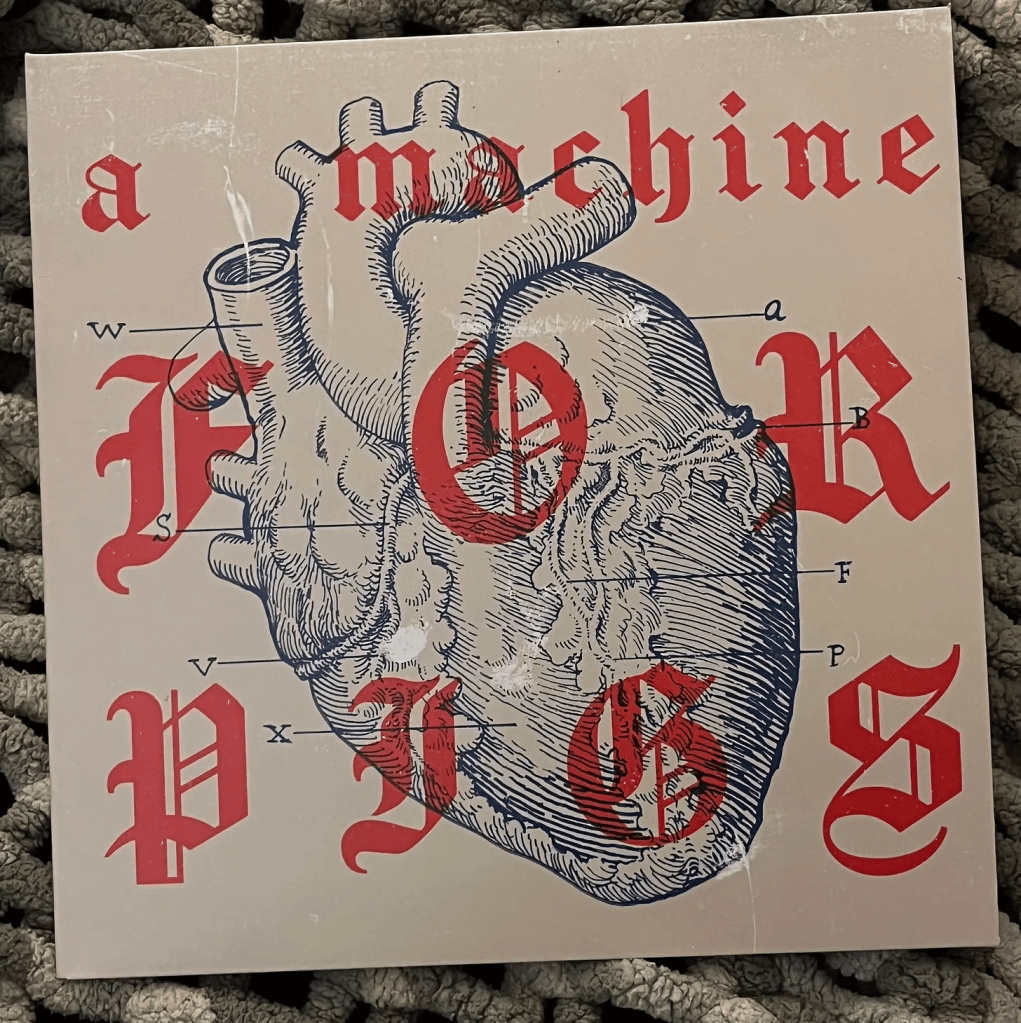
The music for all the games is great, but Pigs has an especially good flavor—elegiac piano, fiery strings, squelchy, scratchy, squealing metal & flesh, and it contains snatches of baroque dialogue (my favorite). You can actually get it on vinyl here. I received my copy the night before posting this essay!
Its composer, Jessica Curry, played over four instruments, including the Zither, the Water Harp, and other musical curiosities for the score. She is also a Substacker with some great essays. Check out her work both musical and wordical!
Now, let’s get nuts.
IV. Rebirth (2020)
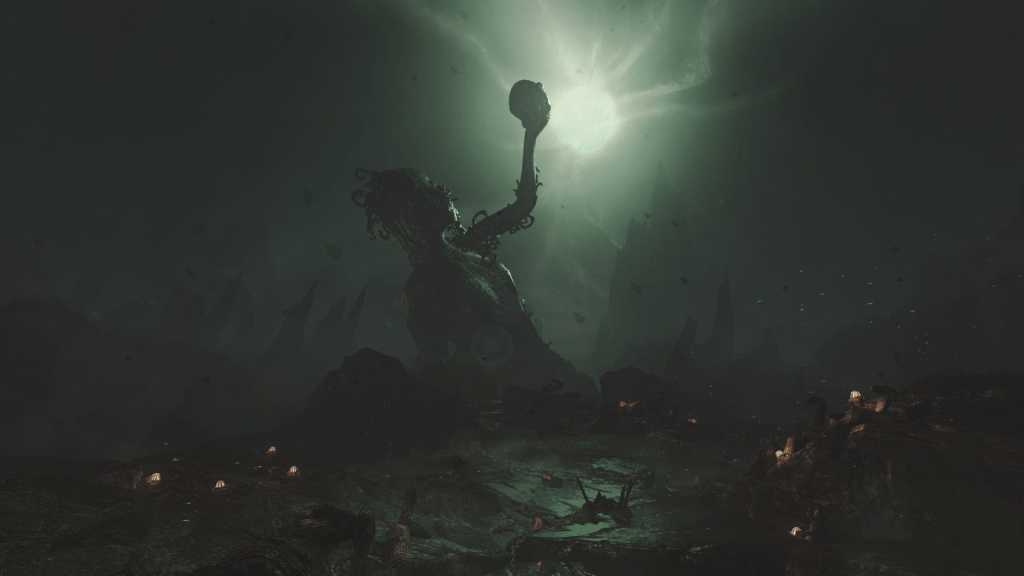
he. The story here is much much more emotional, asking the player to sync up with Tasi’s deepening layers of sorrow. The plane crashes, and Tasi wakes aboard the wreckage, but it’s been some time later. Her fellow travelers have already scattered into the desert amid signs of strange encounters. The journal breadcrumb trail helps Tasi remember what the survivors experienced and where they ended up. The game is still called Amnesia after all!
Tasi’s backstory is provided in interstitial illustrations styled as Tasi’s own drawings. She and her husband, Salim, had a child in Paris, but she died from an unnamed medical condition early in life. When the game starts, Tasi is pregnant with their second child. Salim was on the flight with her, and she discovers his freshly dead body early on. Thus twice bereaved, Tasi trudges into the desert in search of her future. The grief she carries is profound. The annihilation of her family, coupled with the terror of preserving the fragile spark of fetal hope creates an atmosphere of immiserating dread. The vibes in this game are rank, but Tasi marches forward despite it all.
We soon come to learn that the desert region hides fractures in reality, thin spaces where an ÜberKosmos slips through. Rebirth throws open the door to the source of all the magic in Amnesia. Gone is subtlety—you travel directly to this Other World, and discover where the mumbo jumbo womb. Under the emerald glow of a black hole sky, Tasi explores the ruins of an eldritch Egyptian-esque techno-necropolis, where the last despot of a decayed dynasty nurses an immortal power-addiction attended by cannibal Harvesters and banshee Wraiths.4
Empress Tihana cannot live without a constant supply of Vitae, the energy generated by human suffering that has powered this whole franchise. The scope here transcends the setup from previous games. Tasi traverses battery fields where the regime keeps victims suspended in eternal torment. There are cage complexes where captives are routed by terrifying Harvesters to maximize the yield of their suffering. Facing the sarcophagus, you peer into the cimmerian depths of the wretched’s deathless caskets and scry the black mirror of our world which also exploits the pain of the colonized.
You discover the skeletons of men mentioned in The Dark Descent to have vanished years prior. You find the remains of the expedition Daniel embarked on that begat his own curse. You whirl through caves and corridors straight out of Hellraiser, knowing this is where the sinister Alexander of Brennenberg cut his torturous teeth. You discover records mentioning a figure named Ayandra the Apostate who pioneered a potion of obliviation and was later exiled for unspoken crimes. Many fans speculate this is Alexander’s true name, and the lack of confirmation is more satisfying.
In contrast to previous entries, the game does not have an obvious sense of pace. A usual Amnesia experience follows a downward spiral, and at the bottommost UnterKosmos the player confronts the final face of doom. But here, Tasi is whipped around. She tries to reach a desert town, but falls into caves with strange architecture. She discovers portals that she hopes will take her home, but they only plunge her deeper into the shadowlands of blackest night. There is a face of doom, and it is everywhere you look.
Then things get crazier. When Tasi uses the portals, time warps in a way that accelerates her pregnancy several months at a time. By the end of the story, the player actually gives birth and nurses the child onscreen, naming her Amari. It’s an exceptional game element. The pathos is off the charts. To assuage Tasi’s crippling fear, the player can hold a button that will make her look down and touch her belly, gravid with child. She gives comforting whispers to Amari and is comforted herself.
And boy does she need comfort. The horror here is harrowing. At one point, Tasi comes across one of her fellow passengers, a gay man, being tortured by a silent Harvester. In his screaming agony, the victim renounces his sexuality as “an abomination before God,” assuming that’s what the Harvester wants to hear, but the torture doesn’t stop. Remember when I said rank vibes? It’s a particularly shocking moment and completely unnecessary in the larger scheme of things, just a naked morsel of horror on its own. The last game I recall satirizing bigotry like that was Bioshock Infinite (2013). You can feel the developers’ desire to push boundaries in a genre where few lines remain uncrossed.
It was very unique to play a heavily pregnant woman enduring an eldritch nightmare beset by carrion jaws and heartless gods. Another tricky aspect: you never actually die. Each time a monster catches Tasi, she blacks out, receives flashing charnel visions, and awakens randomly spawned elsewhere in the map. She looks down and watches black veins creep up her arms—a curse is spreading through her body that will turn her into a ghoulish Harvester.
Fearing this is infecting the baby, Tasi undertakes the horrifying torture of an innocent captive to generate the Vitae that might cure her. It’s a puzzle room, where you choose which violent implement (knives, fire, or water) will be used on the victim’s body. You may also pass this room and not torture him. This echo of Daniel’s plight ties everything back to the original sin of the series—the innocent suffer for the gratification of the powerful. Tasi’s gruesome parental responsibility harkens back to Mandus. Her struggle with feasting on despair puts her on Justine’s well trod footfalls. Rebirth recrowns a trilogy of terror after Amnesia’s decade-long reign.
I enjoyed the game, loved traipsing around the skeletal realm like a lost soul in darkest Carcosa. Tasi is a very engaging protagonist. I’ve definitely got a soft spot for world-building sinew, but the shape of a truly alien civilization will always be more wondrous in a reader’s imagination. Ruins are important to Weird Fiction. The journey through The Night Lands. The corpse-city of R’lyeh. The city waiting At The Mountains of Madness. The shapeless Plateau of Leng. The shining Elder Pharos. “Non-Euclideon geometry” is invoked so frequently in describing Weird geological locations precisely because it tests the mind’s very capacity to picture it. The whole genre survives under an unbreakable placental wall of “what the fuck is that?!”
Rebirth certainly takes its cues from the masterworks; the Other World is meant to live up to this tradition, but in my opinion it falls short because it breaks the cardinal rule of showing anything at all. All that mysterious “Yellow King magic” vanishes once you pull off the pallid mask. Exploring fiendish workshops, cagey dungeons, and battery farms ironically drains them of their power now that the light has been switched on.
I can’t help but feel let down by the portrait of the Other World. I was imagining a proper Wayne Barlow painting and got something closer to unused concept art for Alien: Covenant. But that’s only natural. That’s the point of anticipation and obfuscation. I still love a good romp through a horror maze, but don’t expect me to kneel before the throne of Azathoth if you render him in only three dimensions.
Speaking of throne rooms, the finale is a lot of fun. Tihana’s physical form is revealed to be a large flowering brain with her nude cerulean-skinned humanoid form mid-meld into tendrils of gyri. Her heavy movements send shivering ripples through strange coral growths throughout her throne room. You use these to hide from her death ray gaze (if you betray her). The villain is essentially a fetus controlling her own womb from which she’ll never emerge, commanding a parasitic empire on a broken wheel of history—a dazzling symbolic foil to Tasi’s maternal quest.
In the end, Empress Tihana reveals that she infected Tasi with the ghoul curse. And she wants Tasi’s baby for herself, declaring that the same affliction that killed Tasi’s first child is in Amari, who won’t survive without the technology that has extended Tihana’s life. This had been proffered to Tasi after the plane crash, but the mother refused and fled. The horror of it triggered the amnesia that begins the game.
The player has three choices of how to complete the tale: fight, flight, or fawn. Defy Tihana and destroy her tower but doom Tasi and Amari along with it. Escape her clutches and activate a portal to Paris while Tasi’s husky voice betrays her emerging ghoulism—and if Tihana is to be believed, Amari will congenitally die young. Or submit to the curse and watch through the eyes of a beast while Amari grows up as the princess of doomland. That ending includes a tag where Tasi—a snarling ghoul—hides a drawing where she hopes Amari will find it.
None of the choices are ideal, but none dispenses outright cruelty. The most destructive choice actually ceases the most suffering, as you see the entire empire of torture shut down (smothered by The Shadow from The Dark Descent). I was able to select all the endings, replaying from a save file before the throne room, reveling in the spectacular trifocal climax. I chose fight, flight, and fawn in that order.
No extra reading, but early in the runtime, Tasi discovers the body of another passenger and friend, a German woman, with a hand-written lullaby, Der Mond ist aufgegangen (“The moon has risen”). Its translated lyrics actually tie into many of the game’s themes, which I found quite powerful. Look at these smartypants hiding my own heart strings for me to find and tug.
Tasi’s tragedy is fascinating. It reminded me of A Machine For Pigs with the age-old parental paradox: With a clear-eyed view of the blatant horrors of the world, both natural and manmade, how can one justify bringing a child into it? Rebirth turns it inside out: If you had to kill someone—if you had to torture someone—if you had to torture a whole population just to give your offspring a chance at life, would you do it?
The answer is obviously fucking no, but it makes for a hell of a video game.
Deeper still!
V. The Bunker (2023)
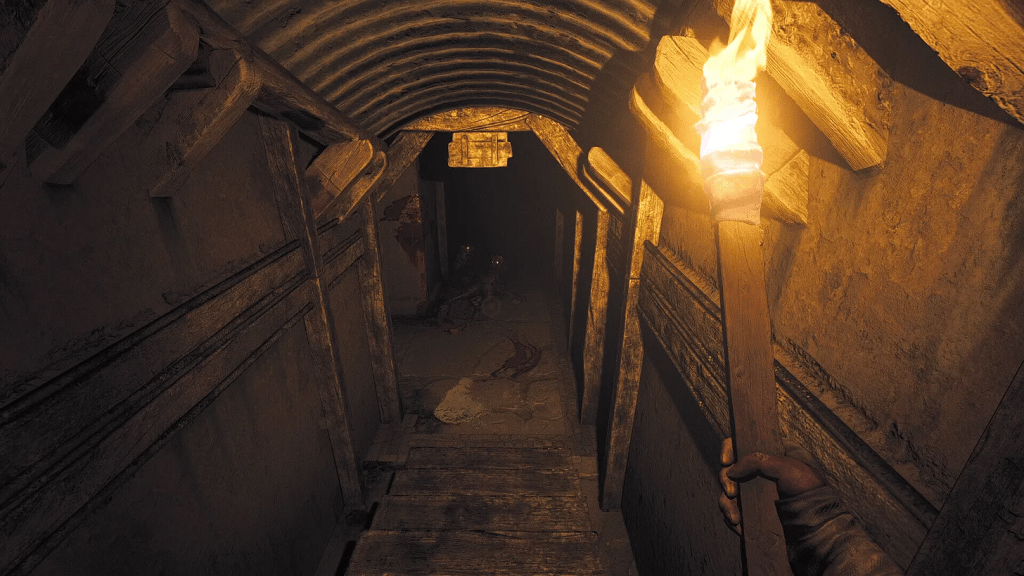
The best game, hands down. Innovative, interesting, and absolutely fucking terrifying. It took me the longest to finish ‘cause I was so goddamn scared. I went whole weeks between sessions, unable to pick it back up and return to the looming gloom. When I finally hunkered down and finished, I knew I had shared in one of the best Horror gaming experiences yet created. If you think I’m being hyperbolic, play it yourself and tell me I’m wrong.
It is 1916. You play Henri Clément, a French soldier who stirs from a coma and must find a way to escape a desolate WWI bunker while being stalked by The Beast. It’s deceptively simple: navigate the tunnel complex and gather what you need to blow up the exit. Compared to its siblings, The Bunker is minimalist. A shorter, less extravagant narrative and a less fantastical setting, but I felt that the narrow focus enhanced the emotional effect. The epistolary scraps of your fallen compatriots detail their respective descents into madness, mutiny, and murder as they confront the supernatural incarnation of war itself.5
The darkness does not cause insanity, but the unbroken tension is bad enough. You have limited inventory space and must decide what to drop and what to carry back to a safe room where you can strategize. You can only save your progress in this hub, elevating every run into a thrilling do-or-die adventure. Another amazing mechanic: a gas generator that powers the bunker lights. You must collect fuel for it, and use a stopwatch to track how deep you can venture before it turns off, leaving you stranded in the stiff darkness.
Or you can explore that darkness, using makeshift torches to wave off the fangs of mutant rats. If you get injured, the rats will track your dripping blood—which The Beast also follows—until you bandage up with rags lying around. These rags can also be used to craft torches and Molotov cocktails, giving the player a wider variety of choice. Another mechanic that really embodies Henri: you check your “health meter” by raising your hand to see how much blood is dripping down your fingers.
In previous games, combat was impossible. The player could only flee and hide from monsters. Here, Henri is a soldier with plentiful weapons from guns to bombs. But The Beast is ultimately invulnerable and can only be warded for a moment. Your sparse ammunition is better used for clearing obstacles, which of course draws the creature out. Strategic use of resources becomes the name of the game here, and the randomized dispersal leads to a wide range of fun uncertainty.
The Bunker does not hold your hand. You need to pore over documents and maps to find out where to go and what to find. The game is one big puzzle. There is also the usual delicious cosmic horror, as your comrades realize they share the earth with a real man-eater. These pages read like early Lovecraft. Gone is Yog-Sothothery; here be classic catacomb horror. The experience of the soldiers brings to mind The Statement of Randolph Carter, The Lurking Fear, Pickman’s Model, The Outsider, and of course, The Rats in the Walls. Remember that Dagon is narrated by an escaped P.O.W. lost at sea. Also recall that Hellraiser’s Pinhead’s origin (one of them anyway) is a British veteran traumatized by WWI.
Sometimes cosmic horror really can be that simple: just you crawling around in the dark trying to find the direction away from the throat of doom. The Beast is the ultimate monster, a constant presence in the walls summoned by the slightest sound—even just your footfalls crunching on debris. Up close, you can see its bloodied mug, soulless black eyes, and two bayonets jutting through its thorax. To turn a corner and spot its shape down a corridor is gut-dropping. I play using headphones, so when The Beast emerged near me, its breath came hissing through its mangled nostrils like a cartilaginous crocodile. I would hide and listen to its lumbering snuffles, its tongue sliding across its teeth with a slick snarl. I felt tasty.
A diary entry reveals Henri had tricked his closest brother-in-arms, Augustin, into taking a patrol meant for himself (an act of impish laziness). Augustin was severely wounded on this patrol, and Henri makes a daring attempt to save him, putting himself into the coma that begins the game. Henri also serves Augustin water from a strange pool—never declared to be Vitae, but context clues alert franchise fiends. This pool is also the source of the mutant rats.
Over the course of several nights, Augustin miraculously recovers from his injury, transmogrifies into a hulking ghoul, and begins the massacre while Henri lies in his coma. The coin toss factor really shines, juxtaposing Henri and Augustin as nemeses of chance. It could have been Henri that mutated, but his punishment is just as bad being the last man standing. He and Augustin circle each other over the same chasm that will swallow us all, their only contrast being the specific shape of suffering their bodies trace as they plummet. Gives “war is hell” a whole new meaning.
The Other World from Rebirth makes a cameo in spooky architecture and eldritch physics, but otherwise the series’ larger realm is left out—and it’s all the better for it. There is a fan theory that the unprecedented suffering of the first world war generated the Vitae, like oil seepage. Thus, the game works as an appendagic fable within the series—a bottle episode spook-em-up. There is also a lovely little connection to A Machine For Pigs; it is never declared exactly where the game takes place, but it is 1916, the same year as the Battle of the Somme, where Mandus’ sons were fated to die.
It also echoes Justine, released a full decade prior, in one scene in which a captive German soldier sits bound and blindfolded in a cell. You must open his door to gather an essential tool. If you do, The Beast will come and slaughter him. You have the option to save his life if you distract The Beast and put yourself at risk, or you can leave the kraut to his bloody demise. Does he deserve it? It’s not like he was a Nazi—it’s only WWI!
There are a couple dirty pranks the developers play in their design. One petrifying sequence involves collecting a key from the very lair of The Beast, but once you do it and unlock the door, you discover a hole in the wall that could have been used as a shortcut from an adjoining hall, had you only explored completely. I did explore completely and only went into The Beast’s lair (after much hesitation) so I could collect every diary entry. That’s how much I love you, dear reader.
Turns out the lair is the goddamn bunker chapel, and The Beast has decorated it with horrendously mutilated corpses, with particular attention paid to the altar. Theatrical bugger. There is a revelatory diary entry from Augustin (recall that he became The Beast) found in the confessional, where he describes losing a rabbit toy that he’d intended to bring home to his son. Augustin expressed sickening sorrow thinking of the toy going unloved in the pit.
The player can actually locate the pit and collect this toy. Remember, none of this information is given freely; you must piece it together yourself through narrative excavation. In the finale, Henri is able to throw the rabbit, and The Beast will rush to it and hold it close with a mournful sob. You can use this window to escape or drop The Beast in a chasm, killing it once and for all. This dichotomy comprises the moral choice for the ending.
But before that finale, the greatest sequence in the series takes place. The penultimate peril finds Henri searching for a dynamite plunger in an area nicknamed “Roman tunnels” by the French troops, though an amateur classicalist among them claims they’re older than Rome. They discovered the area while expanding the bunker. This is the Other World cameo: marble statues and columns and glimpses of strange aeons.
The diaries up to now reveal that the call of the tunnels drove several soldiers mad (some really great writing there), and they sealed themselves inside. You can only find a map of the tunnels if you explore a well-hidden corner grate. As Henri enters, you hear the delirious singing of the sole survivor, Toussaint Beaufoy, who has gouged out his own eyes and wanders the ruins with a shotgun, firing at any sound. To make matters worse, it’s foggy as fuck, and distorted silhouettes pass over the walls accompanied by hallucinatory footsteps. It’s one of the eeriest effects in the franchise and made for the coolest video game battle I’ve had in a while.
Beaufoy’s song is an original composition for the game, We Whirl The World, written by the character himself, as is his right as a madman. The pessimistic screed of its lyrics makes for a wonderful pastiche of trench poetry. The very motion of our consciousness charges the “Magic! That turns men into gristle.”
Before, the Other World existed out there, reachable only by desert plane crash. The Bunker places the dark empire of pain right below the surface of our own world. Like a resting predator, it need only wait for one fumbling finger to scratch away the thin skene that guards our placid ignorance from the great truth of existence. Then it reaches into our hearts and swaps blood for the black venom of misery and hate, and it feeds on us forever.
And At The Bottom…
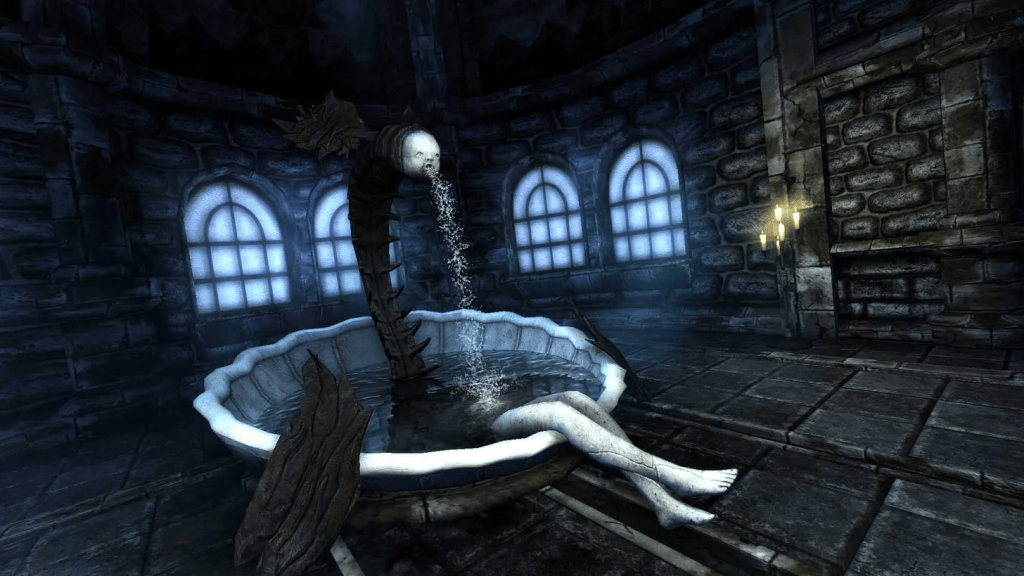
I say again: video games perfect the tradition of Horror. My experiences playing these masterful works haunt and delight me. It isn’t just about riding a roller coaster of shuddering frights—there is a sickening howl of melancholy piercing through the labyrinth of Amnesia. All the characters suffer greatly—monsters, villains, heroes, side characters, bit parts—all wallowing powers the Vitae.
The audience comes for thrills and exits shivering from naked exposure to a universe that preys on their negative energy. There’s a meta-mechanic at work: the monsters magically feed on the characters’ suffering, much like the game developers materially profit off the audience’s giddy terror—and in our age of electronic word-of-mouth virality, the scintillating invitation to creak open the trap door leads to more sales. The moon has risen, and under its pale glow we whirl the world of Horror with white knuckles happily consigned to eternal flames of woe.
So, why? Why play Horror games? Why engage in a diversion that is not remotely relaxing nor actually diverting focus from our world’s devourance, and in fact re-emphasizes its domination? Because the poetry of pain is gone. Now it’s ambient noise. Sometimes I get very cold and very sad. I don’t want to wrap up in a blanket and watch something cute. I need a knife to widen the lips of my weeping wounds. I need to transmute the ambient noise back into poetry. How else is the pain going to mean anything?
For me, Horror games are meditative. I love walking around exquisitely rendered fuckscapes awash in sound designed to make me queasy with anxiety. I love having that tension perfectly shattered by monstrosities bursting forth like wrathful bodhisattvas hungry to throw open the doors of perception and wring the illusions from my psyche. When I get very cold, I acclimatize. When I get very sad, I savor the sorrow. When the poetry is gone, I play with the pain. I drown in the ambient doom.
Also, it’s just plain fun.
- sorry, Silent Hill & Resident Evil. ↩︎
- literally “losing forgetfulness” — aka a five-dollar word for “remembering.” I’ve written about the concept before. ↩︎
- rad. ↩︎
- Journals denote these monsters as the inspiration behind Arabian mythology surrounding ghouls and jinn. ↩︎
- From what I hear, it’s a lot better than Daniel Klaus’ Angel Down (2025). ↩︎

