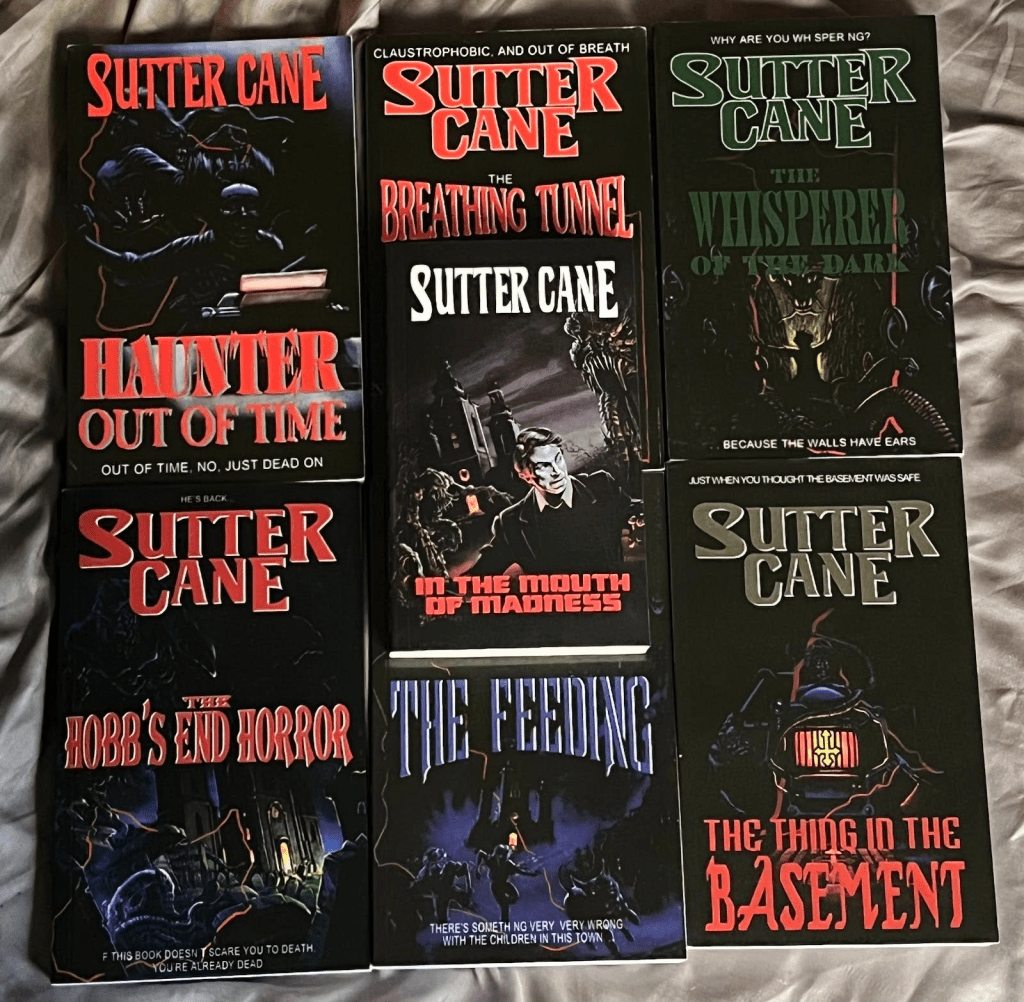
I collect parafictional paraphernalia. You know what I’m talking about: fake things within real things. Hoaxes you can hold in your hand. Nesting doll tales. I boast the complete works of Sutter Cane on my shelf, including the book with actual words between the covers, for which I sacrificed my sanity in a review here. Sutter Cane is Lovecraftian pastiche, which is a fitting place to start: with the original real-fake book.
I. Cursed Texts
In 1935, Donald Wollheim published a hoax review of the Necronomicon in the Bradford Review and East Haven News. Wollheim was a friend of HP Lovecraft, who reportedly found the thing pretty funny. The review does not mention Lovecraft (who of course invented the idea of the Necronomicon), but curiously enough it does name-drop Robert W. Chambers and Ambrose Bierce (both pre-Lovecraft) as “having consulted the work on writing some of their earlier and more fantastic works.” There’s a reason both are mentioned.
Bierce of course gave us the name Carcosa (a word whose origin is much debated), Chambers took that to use in his King In Yellow story cycle, and the rest is Horror history. Wollheim drops both writers into the lineage of a book that hadn’t been conceived during their careers, sealing them into its ongoing legacy. The chief reason all this information is exciting to you is that a Ligottian HBO series picked up the Weird Fiction thread a century later and showered inordinate popular attention on all these obscure writers. I myself bought a copy of The King In Yellow (1895) because of the show. Multigenerational creative collaboration is key here.
Other Weird Fiction writers deposited the Necronomicon in their own tales, leading to readers allegedly requesting copies of the dreaded text from libraries. H.R. Giger titled his own 1977 artbook after the evil tome (instrumental in getting him hired for Alien), himself believing it to be real for a time. Whether or not you buy that people were really fooled is part of the fun (“of course we know it’s fake—we’re in on the joke too!”)
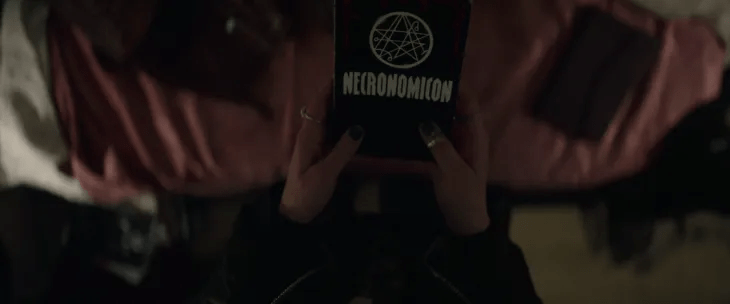
A doubly auspicious year for the book, in 1977, a cabal of literary dorks colluded to midwife the grimoire for our dimension. They coated the faith-phantom in parafictional echoplasm and pulled the wriggling tulpic1 text into the “real” world through various ink and paper portals. Named for its author’s pseudonym, the “Simon Necronomicon” is presented as a genuine spellbook, despite its misappropriation of ancient texts. With the gates thrown open, innumerable flesh-and-blood grimoires now share the same air as us, dreamed into being as we have been.
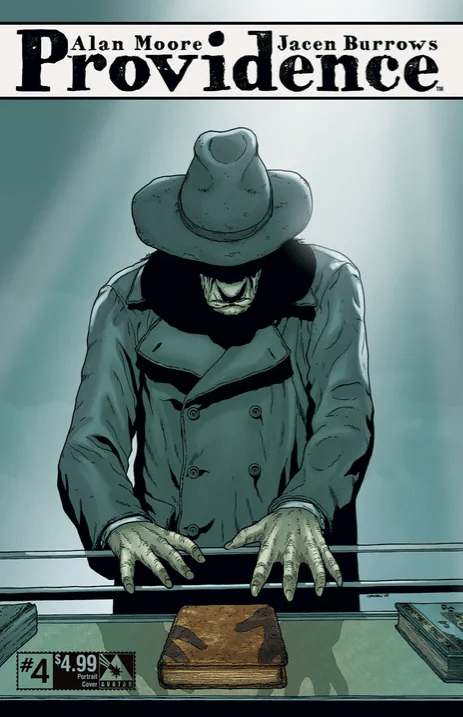
Alan Moore and Jacen Burrows seized upon this thread in their astounding 2017 graphic novel Providence (Avatar Press).2 This ambitious project unites as much Cthulhu Mythos lore as possible, threading it into a tapestry of disparate points of entry, all leading to Lovecraft himself and his influence on modern Horror as it continues evolving. In the climax, Cthulhu dreams himself into the world.
Moore’s thesis is simple: we make the Old Ones real by knowing about them. Or more accurately, they make themselves real by orienting the mechanisms of knowledge to allow passage through us. Moore depicts time as fixed and super doomy. The Old Ones appear to command the animating forces of the universe; even discussing the nature of their existence invites all sorts of tautological bullshit. Put plainly, the Old Ones parthegenetically impregnate our minds through the gnosis of their names. And they spread virally through the network of minds eager to share. Namely, dorky cabals.
II. Cyclopian Encyclopedias
The penultimate issue of Providence features a rapid-fire sequence of panels that rockets the reader through a century of artists and thinkers each adding their patch to the quilt. They include Donald Wollheim and Peter Levenda, secret author of the Simon Necronomicon. There is even a tasteless mention of a real-life murder case in which the Necronomicon was used as evidence against Rod Ferrell and his so-called “Vampire Clan.” Tulpas can also be Tricksters…
As the montage continues into the latter half of the 20th century, they include other obscurely Lovecraftian figures like Kenneth Grant and William S. Burroughs. Curiously enough, there is a panel of Argentine writer Jorge Luis Borges dictating a story. There’s a reason Moore chose him.3
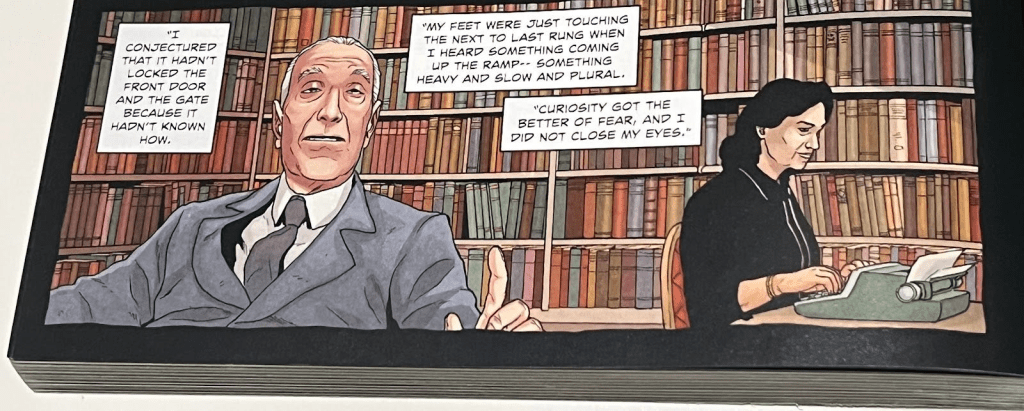
Nicknamed the “Franz Kafka of the Spanish-speaking world,” Jorge Luis Borges was famous for his own labyrinthine explorations of the mind. In his story, “Tlön, Uqbar, Orbis Tertius” (1940) the narrator uncovers a baffling mystery: a network of detailed encyclopedias mapping out every conceivable inch of a fictional version of our planet. Tlön’s exotic conception of time and language forms the foundation of a truly alien civilization. Tlön turns out to be a cheeky anthropological project by a collective of philosophers and “heresiarchs,” nothing more than a joke or a creative exercise.
But something stranger occurs. Before the story can draw to a close physical artifacts from Tlön begin appearing in our world. This escalates to the concepts and languages leaking through, until the real world is essentially colonized by an imaginary one. The map eats the territory, like a squid-monster from outer space.
“Already a fictitious past occupies in our memories the place of another, a past of which we know nothing with certainty—not even that it is false.”
Chris McLaren compares the premise of Tlön to the equally mysterious but very real Codex Seraphinianus.
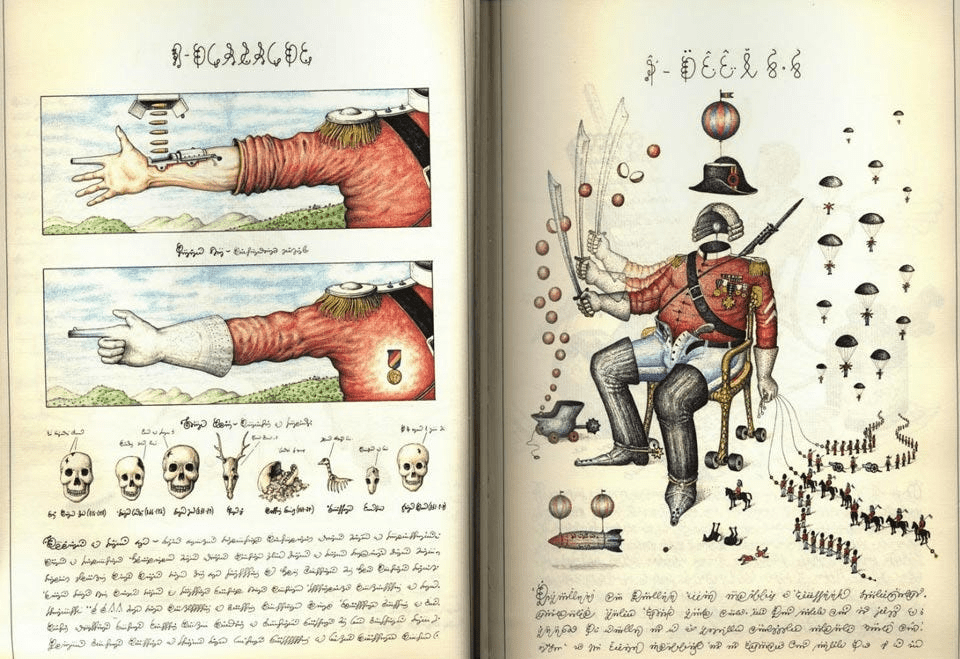
Hoaxes are fun. When they don’t simmer into mean-spirited pranks, I believe we love being fooled. Even if just for a moment, we spy a crack in this materialist (by both definitions!) universe into which we can poke our imaginations and inflate a space-time bubble detailed enough to build a new reality, one for which we can rewrite the laws that govern our enforced mundanity. I suppose that’s why we call it escapism.
I propose we replace it with a better word: if we cannot escape this reality, then by God will we enchant it with our fictions. Spinning a yarn tickles the psychic pleasure of “knowing things,” more so when those things are shared with a special few, our own dorky cabals.
It’s all well and good that humans started swapping tales as a result of our overblown neocortex; it brought us together for a spell, right? But it also led us directly to where we are now: this “media is the massage parlor orgy-porgy fuck-pit” from which we are told there is no escape.
That pleasure of scratching our gnosis has weltered into an itchy rash of information overload. It’s just too much. Too many stories. Too much knowledge. Too much news of real atrocities, images of horror and death invading our umwelt. Too much misinformation gunking up our propaganda filters like pollution in the air conditioning. Too much entertainment trying to metabolize the trauma into the social imagination, and then too much media commentary trying to purify the message into the social spleen.
All we’re left with is over-processed glop. The fiction dribbles down our eyelids like greasy tears from a ramshod feed nozzle squandering the slop. We’ve been colonized by archons of bullshit, all of it coated on top of us like a neo-Platonist cave of dried crud. But if it isn’t gonna stop, then we might as well make ourselves at home. Decorate our trough with little vomit crystals we’ve carved ourselves. Fetishes of the Anthropocene.
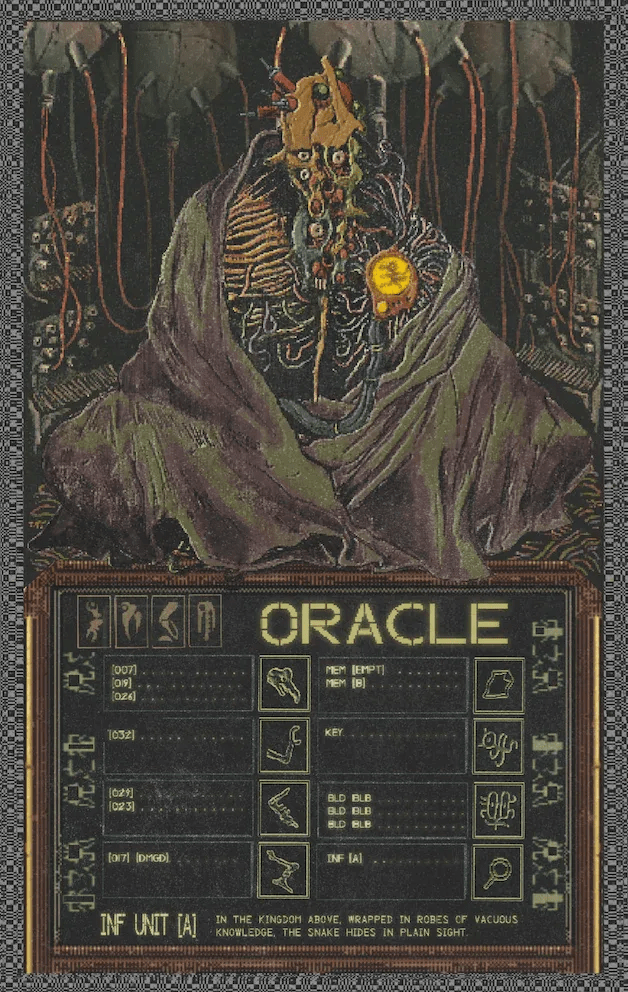
Speaking of pukey nightmares, the artist Plastiboo has made excellent work in the realm of encyclopedic fictions. They’ve created a series of art books styled as strategy guides to video games that don’t exist. Vermis is a dark fantasy dungeon crawl of sordid sword & sorcery, complete with its own very real synth score composed by Joshua Karlson (aka Radagast).
Godhusk (my personal favorite) is a post-apocalyptic biopunk scuzzscape that puts I Have No Mouth And I Must Scream to shame. Everything’s so disgusting and evil. The details are crafted with such care, that your eyes can pick up the love as they scour the scum. The appeal of these projects is easy to enunciate: “I wish these games existed.” Or rather, “I wish I could get lost in these worlds.” Or even just, “I wish I could escape my own world.”
The worlds of our art are our wishes, struggling to be born in the physical world. We are not creating an exit but an entrance into a reality tessellated into the shared fabric. It’s all one place. There is no escape, only deeper wrinkles. Again, we are trying to enchant our world. How long until a bunch of dorks conspire to make Godhusk a real game? The artist offers us a chance to enliven our immiserated existence with a touch of the transcendent (“what if the cursed book really does exist? What if I wrote it? What if the book is calling me to write it…”)
III. Tulpaverse
I told this story when I appeared on Beauty Of Horror, but when I first watched Beyond The Black Rainbow, I completely assumed it was made in the 1970s. It was only the morning after when I read the film’s wiki page that I learned it’s from 2010—Panos Cosmatos had tricked me. I experienced a delectable derealization in that moment; my sense of time contracted and leapfrogged the film four decades to reside in the present day. My imagination enchanted the empty time with nonexistent lore in collaboration with Cosmatos’ sensibility of poisoned nostalgia. That experience alone makes it one of my favorite films.
Chief among the Cosmatos’ cultists is an artist who goes by Cosmic Evil Toys. He creates items in the style of mainstream pop merchandise but for psychotronic fixations. He’s a particular favorite among King Gizzard fans. I myself have his Barry Nyle toy on display. We are all part of the same dorky cabal.
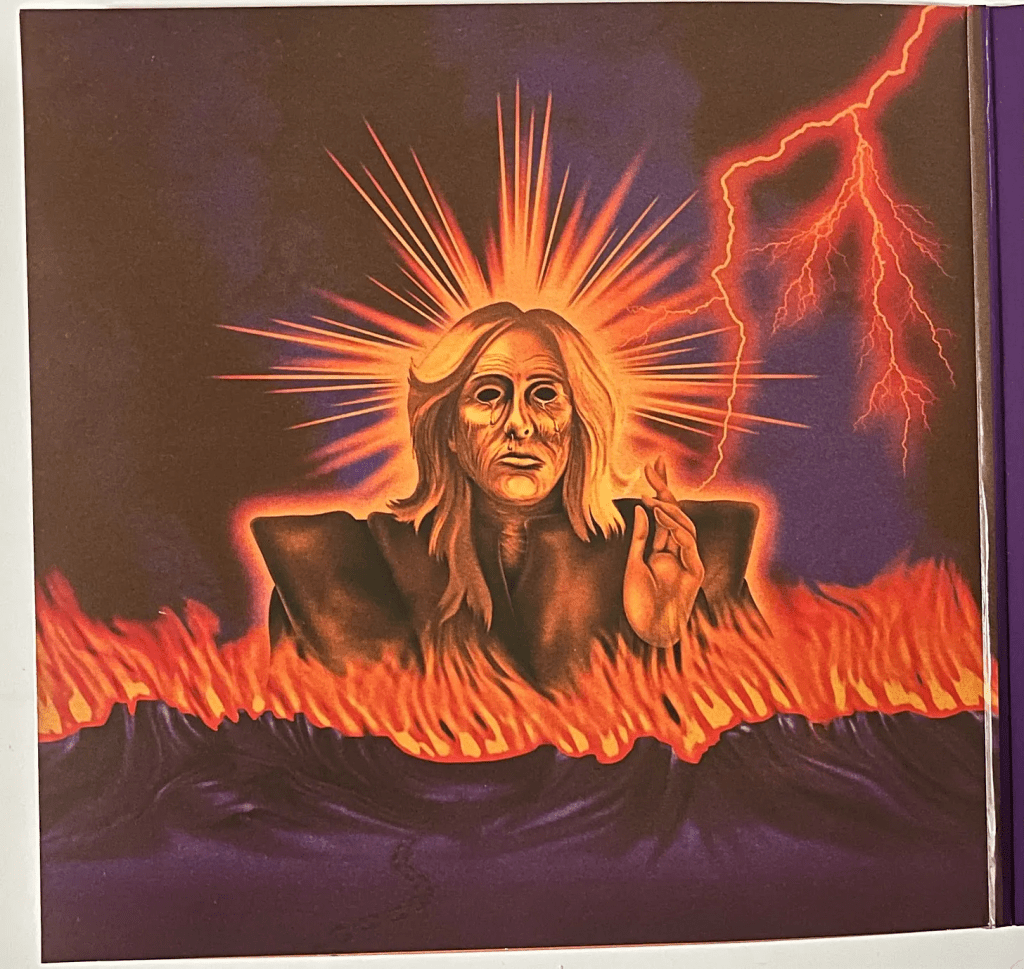
Another prize in my metafictional menagerie is Lift It Down, the vinyl record created by Jeremiah Sand, the villain from Cosmatos’ second feature, Mandy. Almost as if they knew about my self-imposed Black Rainbow hoax, Sacred Bones presents the record as a truly unearthed artifact by a mysterious cult-leader from the ‘70s. The effort they put into it is wonderful. They even composed a titillating tale that you can read on the site. For its production, they got actor Linus Roach to perform Sand’s vocals. The liner notes were written by Genesis Breyer P-Orridge who passed away only three months later (you could turn that into a spooky coincidence if you want!). And best of all, the music is terrible in a way that makes sense for the character. Yet another amazing invasive relic from Tlön. 100% worth the purchase.
Lift It Down resides on the shelf with a few music scores for films that don’t exist—in particular Psychic Shield by Slasher Film Festival Strategy and The Obelisk OST by Adam Egypt Mortimer (which I wrote about here). It tickles a particular fancy to imagine the movie that could be. This allows my creative impulse to take over for my cataloging drive, which as I stated before is exhausted by the constant demand to know things by a rapacious panopticon. I find respite in these particular fixations, because I really do feel like I’m connecting with someone who gets it. These artists are inviting me to be in on the joke, and I’m happy to laugh. These objects reside at the nexus of open-ended collaborative daydreaming, which I find nourishing on a spiritual level.
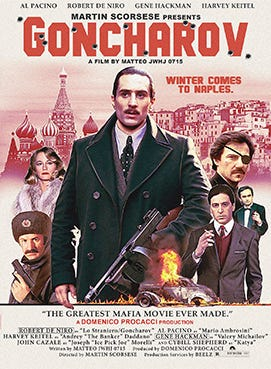
Okay, one more and then I’m done. In November 2022, a meme took flight for a made-up movie called Goncharaov. Even Martin Scorsese joined in the fun of pretending he produced or maybe directed it (his role is disputed). It was easy to partake; just mention the title and scribble some clever factoid about the making of or physical release or what have you. No one’s in charge. Anything goes. Sometimes, it feels like we do it as a sort of satire nestled in the recapitulation of our capitalist dogma. If we must do nothing but consume media and its fetishes, then we shall do what humans do and fetishize this shit into the dirt.
Prattling on about a fake movie in faux film bro lingo is more fun than earnestly arguing about Christopher Nolan’s suspected politics or collapsing into histrionics over the Stranger Things finale. Sometimes it’s more fun to support another lonely soul and pore over his unmade video game world, rather than fork over countless hours, dollars, and data to soulless media conglomerates. Instead of living and dying by their rules, maybe we can sew this tiresome consumerist mess into a mask and delight in the shared humor of its hollowness.
Because that’s why we really do it: sharing. We want to feel connected to other people again, like we first did when we discovered the magic of shared universes in our books, movies, and video games. It wasn’t just about gathering cold hard information, knowing the lore, but about knowing other people. If we know the things they know, then that brings us closer to understanding just what the hell being a social animal means at all.
It’s not about recognizing Cthulhu, Yog-Sothoth, Azathoth, Hastur, and the others. The names are merely vessels for meaning, which is itself useless when not suspended between minds bound together by the common cause to know. That’s the foundation of culture. Right now, our culture is created top-down and sold to us as a diversion from our oppression. In these, our beautiful scum-puddles, we brew our own subcultures, and we can spit in their faces when it pleases us.
If the religious instinct built a social membrane to cradle humanity, and the capitalist demiurge commandeered that instinct into a carceral media trance, then perhaps we’ve yearned our way back around to something we can apprehensively call “community.” It feels warm, cozy, and welcoming inside the joke. Why don’t you join? Crack open the Necronomicon, sign your name among the others, help us dig a new reality-tunnel out of the hall of mirrors.

Thank you for reading. If you’re interested in more of my work, consider checking out my own contributions to the Weird Fiction tapestry:
- I invoked Clark Ashton Smith’s dreaded Tsathoggua in a comedy-horror short for my clown character Dr. Bendigan.
- I have echoed Frank Belknap Long’s Hounds of Tindalos in several stories, in particular “Call Me Face Stabber.”
- The tale “Gotta Light?” is dedicated to my favorite Old One… and yes, the title is also a Twin Peaks reference. That one is not available online, however. If these strange tales have piqued your interest, consider purchasing the whole collection, Drippy Trippy Doom, at the link below. A reasonable price to keep the virus burning through fertile minds. Melt well, umwelt fellas!
- In traditions of mysticism and the paranormal inspired by Tibetan Buddhism, a tulpa is a materialized being or thought-form, typically in human shape, that is created through spiritual practice and intense concentration. ↩︎
- Much of my research on Providence is bolstered by this jaw-dropping fan-led project annotating every inch of the graphic novel series and its adjacent works. Moore-heads don’t fuck around. ↩︎
- I can’t take credit for making the Borges/Lovecraft connection. This excellent comment by user Brian J. Taulbee is actually what got me reading Borges in the first place. Thanks, Brian! ↩︎
 Doompunk Dispatch