Last Halloween, I began a column called The Plasma Pool on my dear friend Chandler Bullock a.k.a. Shockaholic‘s website Beauty Of Horror. My first piece is about CONTROL within the filmography of David Cronenberg.
While I have you here, I’ll go ahead and give you this taste for free. My journey with Papa C. started my last year of college. All my life I’d heard his name uttered with reverence in horror and science fiction circles. So I finally went about eradicating my hymen with the utterly magnificent remake The Fly (1986), which turned out to be a romantic-tragedy–cum-vomitous-monster-mash.
The Fly gave me everything I wanted and more from a horror movie: the misuse of potentially world-shaking technology, timeless practical effects played in concert with a talented performer, a shambling humanoid mutant as heart-wrenching as he is gut-churning, and Jeff Goldblum puking on a donut. I learned that Horror could be used for more than just frightening the audience. The best artisans understand that the emotion from which the genre takes its name draws on the deepest well of human experience. David Cronenberg roots that experience in the very vehicle that mediates our individual realities: the body. The auteur finds no shortage of revulsion and wonder while diving deep into The Flesh and its speculative shapes.
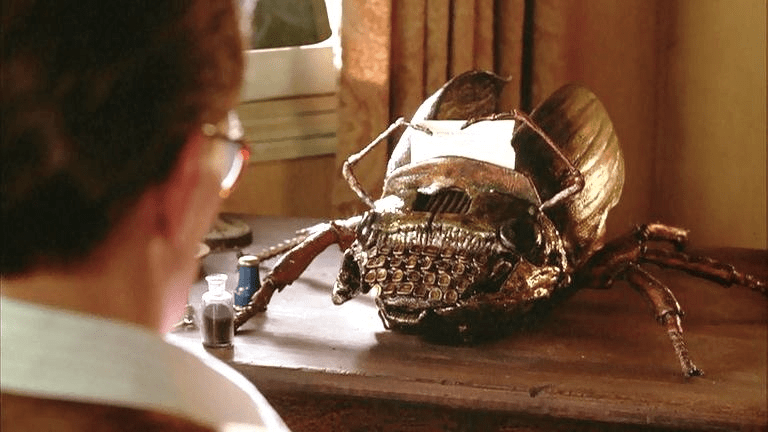
Wounded by this first viewing, I craved more. The virus had planted itself in my nervous system and commanded me to seek out nutrients for its psychogenic needs. I went on a Cronenkick and devoured a good chunk of his corpus in quick succession. I quickly discovered that I wasn’t going to get another large & luscious monster like my precious Brundlefly––until the Mugwumps of Naked Lunch (1991). Organ-sized parasites heralding microscopic pathogens form the main threats to these doomed visions of Toronto.
I also found myself awash in a murky sea of enigmatic themes. Below the slimy surface waited a slew of philosophical influences I had never heard of: J.G. Ballard, William S. Burroughs, Marshall McLuhan, and more. I realized I was not going to have my hand held for this dissection and had to figure out how to hold the scalpel. But the virus was hungry and wouldn’t allow me to hesitate.
When it comes to recommending the filmography, I always warn new initiates that a body of work spanning a half-century undergoes several transformations. Here’s a quick rundown of his grand squelch across the upper quarter of the 20th Century. In addition to his nonstop ’80s hits, I find Cronenberg’s opening salvo a fine introduction. Its alternate title reads as a mission statement for the artist’s pluralistic philosophy: They Came From Within (1975). His working title was Orgy of the Blood Parasites because he’s hilarious (seriously, listen to his commentaries). Most know it as Shivers, and it holds up. “Disease is just love between two kinds of alien creatures.” What more do you need? Plenty, says the virus.
In Rabid (1977), the psychosexual Frankenstein is the result of a botched plastic surgery on a character played by a real-life adult film star. Scenes of her preying on victims resemble the openings of pornographic encounters, then it all ends on the quivering tip of a venereal apocalypse. The Brood (1979) remains one of Cronenberg’s best, introducing his obsession with psychiatry as another gangrenous limb of Mad Science. The first full-bodied, albeit pint-sized, mutants make their appearance. The performances are stellar, especially Samantha Eggar. It’s an essential watch for plumbing the mysteries of how the mind and body create reality, and that’s not a metaphor. He would pursue this thread for the rest of his career. Scanners (1981) is a damn fun time, plenty of practical effects to keep sloppier fans happy. The Dead Zone (1983) is also worth the watch. This was the golden age of psychokinetic tumors.
Speaking of tumors, Videodrome (1983) actually tripped me up. It took three viewings for me to feel like I finally “got it” (a phrase I always cringe to use). Now I see it for what it is: a psychotronic masterpiece made new flesh. I say plenty about it in the second part the main essay, so I’ll save it for now. It took less than a decade for the artist to make his medium-defining accomplishment, then he went ahead and kept making movies that would keep us guessing––and gushing.
Dead Ringers (1988) is a fan favorite among perverts and weirdos and for good reason. Gone is the sci-fi but stronger is the psychological torment. David’s love affair with Jeremy Irons would continue in M. Butterfly (1993), a startling tragic romance about the dalliances entire nations are capable of when using human bodies as their devious cogs. Deeply emotional and, even when stripped of the special effects, deeply Cronenberg. After watching Naked Lunch, I immediately (and I do mean immediately after it ended) walked out and bought a copy of the book. This was my explosive exposure to William S. Burroughs, whose influence would come to dominate an entire phase of my writing in years to come. The ways I define words like “virus” and “control” are deeply informed by that queer scribe.
I made sure to read J.G. Ballard’s novel before watching Papa’s 1997 adaptation of Crash. Another dimension opened up there. Dropped was splashy science-fiction and fully adopted was techno-psychopathology as the dominating pharmakon of the late 20th century––just in time for society to suffer the cost of such living when the 21st came crashing through the ceiling like the jaws of a junkyard wrecker. Crash is simply another masterpiece. Bring tissues (wink).
At the behest of these driving forces, I bought Marshall McLuhan’s vinyl record The Medium Is The Massage and deepened my education to its source. David Cronenberg names the cultural philosopher his strongest influence. The virus within me resonated with the singing wax grooves, and I finally came undone. Screen and page and sonic cavalries finally converged to reshape my life. I am altered irrevocably by these lymphatic ideologies. The concepts course through my veins like rancid venom, gestating new futures in my insipid lipids. Like the scabrous mutation in Tetsuo The Iron Man (1989) or the steel baby in Titane (2021), a whole new world bursts from within and reshapes me: mind, body, and soul. And like those works synchronous to the Cronenbergian tradition, I know I am not alone.
I owe Papa C. a heavy debt for this period of my intellectual development. He knows how to philosophize but not too much to still have fun. He can crack a joke, bust a head, bust a nut, gross you out, and break your heart. So take the plunge. See how deep you can cut and let the wound take hold. I promise it’ll carry you to surprising places.
Death to eXistenZ (1999)! Long Live The New Flesh!
If you like what you see, consider following the link to my essay on Beauty Of Horror.
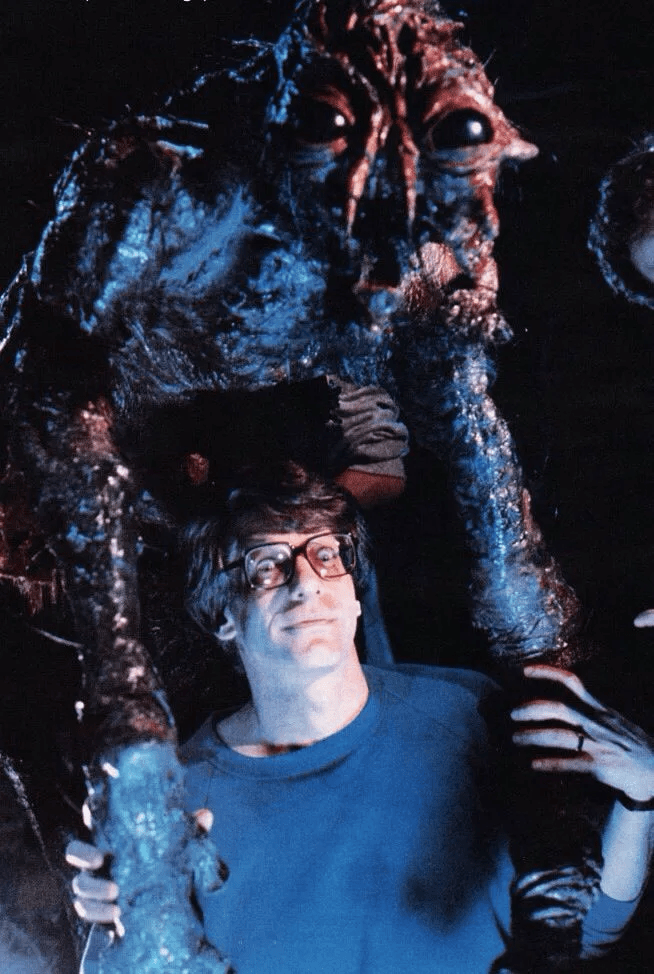
And be on the lookout for Part II: Evolution Is Inevitable!
 Doompunk Dispatch